How Three Ordinary People Changed History
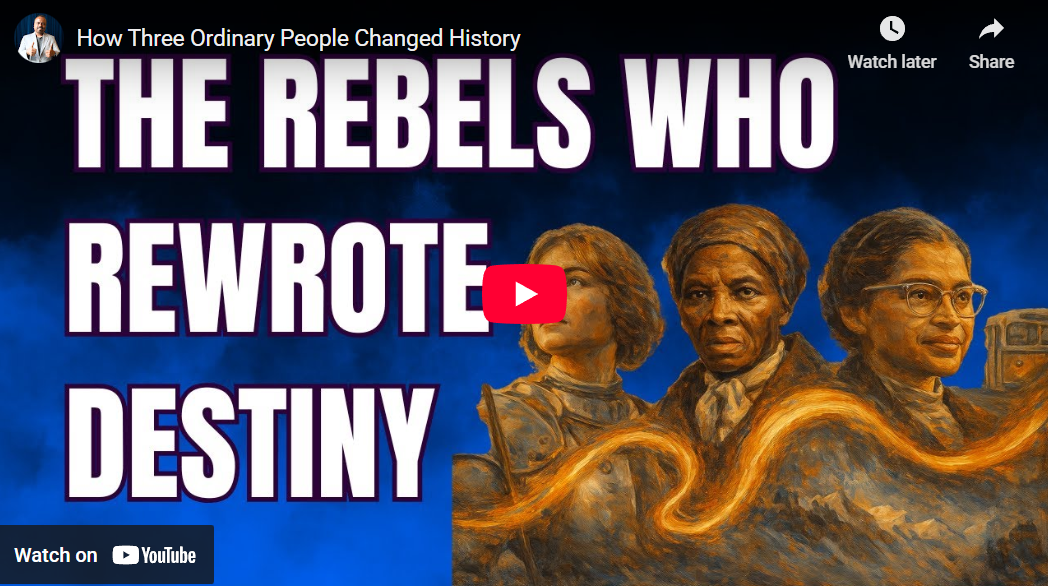
The Rebels Who Rewrote Destiny: How Ordinary People Changed History with Extraordinary Courage
History often highlights kings, generals, and empires. But when you look closer, the world has been transformed just as powerfully by people who held no titles at all. Ordinary men and women, driven not by authority but by conviction, have rewritten the future for millions.
This article explores the stories of three such individuals — Joan of Arc, Harriet Tubman, and Rosa Parks — rebels who proved that destiny isn’t inherited. It’s created, shaped, and fought for.
Joan of Arc: The Girl Who Refused to Wait for Permission
France in the 1400s was a nation on the edge — exhausted by war, fractured by politics, shaken by defeat. Armies failed, leaders wavered, and hope grew dimmer with every passing day.
Then, out of a quiet village, came a girl who believed she had a purpose larger than herself.
Joan of Arc, a 17-year-old farm girl with no military background, stepped forward claiming she could help save her country. She entered the battlefield not with a sword, but with a banner and unshakable conviction. Her courage rallied soldiers who had long forgotten what victory felt like. Under her leadership, battle after battle turned in France’s favor.
When she was eventually captured and sentenced to death, she didn’t plead for mercy. She stood firm and declared:
“I am not afraid. I was born to do this.”
Joan’s rebellion wasn’t built on violence — it was built on faith, purpose, and the belief that one voice can ignite a nation.
Harriet Tubman: The Woman Who Turned Freedom Into a Mission
Crossing the ocean and stepping into 1800s America, we enter a world divided by slavery — a world where millions were forced into lives of suffering, and where even a dream of freedom was dangerous.
But one woman refused to accept that future.
Harriet Tubman escaped slavery, but she didn’t stop there. Instead of running toward her own life, she ran back — again and again — to rescue others trapped in bondage. Over the course of 19 rescue missions, she led more than 70 enslaved people to freedom, never losing a single life along the way.
Armed only with courage, a revolver, and unwavering faith, she navigated dark forests, guarded roads, and deadly risks. To those she rescued, she became “Moses.” To history, she became a symbol of what bravery looks like in its purest form.
Her motto captured her spirit:
“Live free or die.”
Harriet didn’t change only her own destiny — she changed the destinies of everyone she touched.
Rosa Parks: The Quiet Defiance That Sparked a Movement
Fast-forward to 1955 in Montgomery, Alabama. A tired woman boards a bus after a long day of work. What she does next seems simple — she sits.
But when asked to give up her seat because of the color of her skin, she quietly refuses.
That woman was Rosa Parks.
Her act wasn’t loud. It wasn’t violent. It was a moment of stillness that shook an entire nation. Her refusal to move sparked the Montgomery Bus Boycott — a catalyst for the modern Civil Rights Movement.
Rosa Parks showed the world that dignity itself can be a form of rebellion. She once said:
“You must never be fearful about what you are doing when it is right.”
Her choice on that bus became a symbol of justice, equality, and the power of peaceful resistance.
Three Rebels. Three Destinies. One Timeless Lesson.
Joan of Arc. Harriet Tubman. Rosa Parks.
Three different eras. Three different battles. But one extraordinary truth unites them:
Real power doesn’t come from titles, money, or armies.
It comes from conviction — courage — and the decision to act.
They didn’t accept the world as it was.
They dared to shape it into what it could become.
Their stories remind us that rebellion isn’t always an act of destruction.
Sometimes, it’s an act of transformation — a refusal to stay silent when the world needs change.
And that kind of courage is within reach for all of us.