Marketing has always wanted to feel personal. For years, businesses have tried to make customers feel that a message was created specifically for them. First, it was as simple as adding a customer’s name to an email. Then came customer segmentation, browsing history, purchase recommendations, location-based advertising, retargeting and increasingly sophisticated customer profiles. The more information companies collected, the more personalized their marketing was supposed to become. Now artificial intelligence has taken this to another level. AI can analyze customer behavior, create different versions of a message, recommend products, write emails, generate social media content and help businesses communicate with thousands of people almost simultaneously. In theory, marketing has never had more tools for becoming personal. Yet something unexpected is happening. The more technology makes communication personalized, the more digital marketing can start to feel strangely impersonal.
You have probably experienced this yourself. You open LinkedIn and see a post that starts with a dramatic statement, moves into three lessons, ends with a question and looks as though it has been carefully designed to generate engagement. You open an email that uses your name, mentions something you recently viewed and recommends a product that supposedly matches your interests. You watch a brand video that is beautifully produced, perfectly edited and completely forgettable. None of these things are necessarily bad. In fact, many of them are technically excellent. The problem is that they can feel interchangeable. You could replace one company with another and the message would still work. That is where the real challenge for marketing begins. AI has made it easier to personalize the message, but it has not automatically made the relationship more personal.
This distinction is going to become increasingly important as AI becomes part of everyday marketing. When creating content required considerable time, effort and money, the amount of content a company could produce naturally had limits. A marketing team had to decide which article was worth writing, which campaign deserved attention and which customer story was worth turning into a case study. AI changes that equation. A single marketer can now research an idea, write a draft, turn it into social posts, create an email, produce a video script, generate images and adapt the same concept for multiple audiences in a fraction of the time. The ability to produce content is no longer the major constraint. The question is becoming whether the content is worth consuming in the first place.
That is a very different marketing problem. The internet is not suffering from a shortage of information. People already have more information than they can possibly consume. Their feeds are full, their inboxes are full, their notifications are full and their attention is constantly being divided between platforms, brands, creators, colleagues, friends and communities. In that environment, producing more content does not necessarily make a brand more visible. Sometimes it simply adds another piece of noise to an already crowded environment. The companies that stand out may therefore be the ones that understand something more fundamental than content production: people are not looking for more messages. They are looking for messages that feel relevant, useful, interesting or genuinely human.
This is where the idea of humanization becomes particularly interesting. Humanizing marketing does not simply mean putting a smiling employee in an advertisement or making every social media post sound casual. It means allowing actual human experience to enter the communication. It means explaining why a decision was made, acknowledging when something went wrong, sharing what the company learned from a difficult experience, allowing employees to speak in their own voices and giving customers a reason to believe that there are real people behind the brand. There is a significant difference between a company saying that customer satisfaction is its highest priority and a company explaining that a customer waited three days for a response, that the company discovered a problem in its internal process and that it changed the system because of it. The second message feels different because it contains experience rather than simply a claim.
This is also why founder-led content has become so powerful in digital media. A company can produce a beautifully designed campaign about entrepreneurship, innovation or customer obsession, but there is something fundamentally different about hearing a founder talk about the moment they nearly ran out of cash, the product they launched that nobody wanted, the customer complaint that changed the business or the decision that kept them awake at night. AI can help turn those experiences into polished content, but AI did not live them. The experiences belong to the person. That gives them an authenticity that is difficult to manufacture.
The same principle applies far beyond founders. Employees have stories. Salespeople hear unusual customer objections. Customer-service teams see problems that never appear in executive reports. Product managers discover unexpected ways customers use a product. Managers learn lessons from failed projects. Engineers encounter problems that force them to rethink assumptions. These experiences contain something incredibly valuable for marketing because they are specific. They are not generic advice about leadership or innovation. They are real observations from inside the business.
This may be one of the biggest opportunities AI creates for marketing. Instead of using AI primarily to manufacture ideas, companies can use it to amplify ideas that already exist inside the organization. A customer conversation can become an article. A sales team’s recurring question can become a video. An employee’s experience can become a LinkedIn post. A product failure can become a case study about what the company learned. A founder’s story can become a podcast, newsletter and social campaign. AI can take one genuine experience and help distribute it across multiple channels without requiring the marketing team to recreate the work from scratch each time.
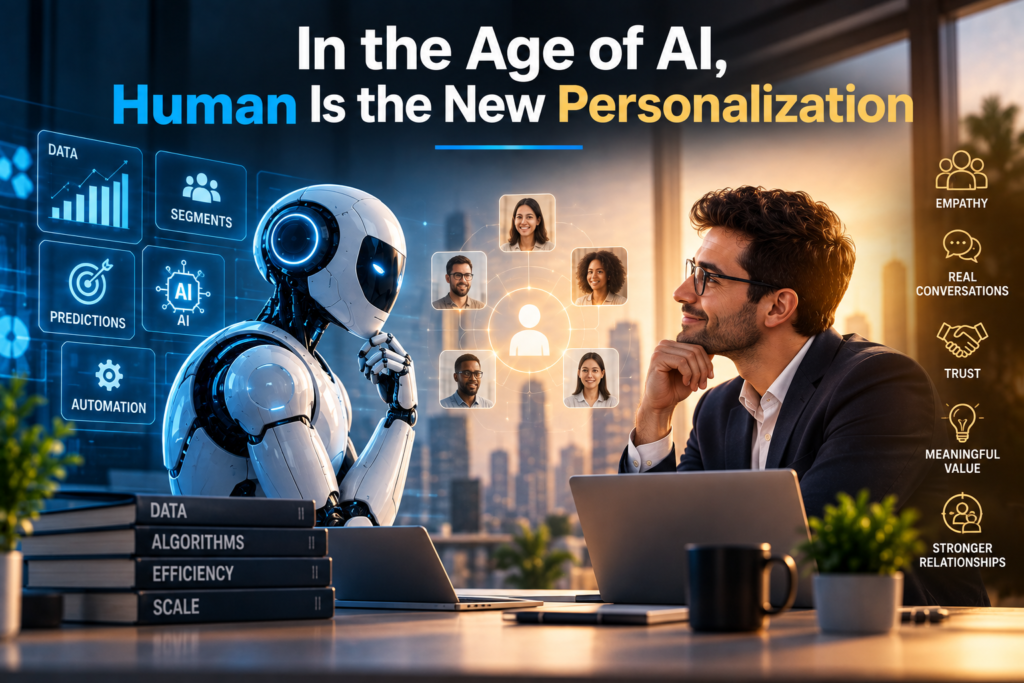
In that sense, the most valuable marketing workflow of the AI era may not be human versus machine. It may be human experience plus machine scale. The human provides the perspective, the context, the story and the judgment. AI helps research, organize, edit, repurpose, personalize and distribute it. That relationship is much more interesting than simply asking AI to produce another generic article about the importance of customer experience.
There is another reason this matters. AI is becoming increasingly good at producing content that sounds confident, polished and professional. That sounds like an advantage, but it can create a new problem for brands. If every company can produce polished communication, polished communication stops being distinctive. If every LinkedIn post has a compelling opening, every email is perfectly structured and every brand video looks professionally produced, those characteristics no longer tell customers very much about the company. The differentiator shifts from how polished the message is to what is actually being said.
This could make opinions more valuable. A company that has a genuine point of view has something to work with. A founder who has spent fifteen years solving a particular problem has observations that cannot easily be copied. A manager who has learned something difficult about building teams has a perspective that is more interesting than another generic leadership framework. A brand that is willing to explain why it disagrees with a common assumption can create curiosity. A company that is honest about a mistake can create credibility. The content becomes interesting because there is a person, experience or belief behind it.
There is also a subtle difference between personalization and understanding. AI can tell a company that a customer opened an email, visited a particular page and previously purchased a particular product. It can use that information to create a highly targeted message. But knowing what someone did is not the same as understanding why they did it. A customer may download a report because they are researching a problem, preparing for a presentation, comparing competitors or simply curious. Data can identify the behavior. Human understanding tries to uncover the reason behind it.
This is why marketers should be careful about assuming that more data automatically creates better relationships. Data is incredibly useful, but personalization can become strange when it becomes too mechanical. Customers do not necessarily want companies to demonstrate how much information they have collected about them. They want companies to understand their problems and make their lives easier. Sometimes the most personalized message is not the one containing the most customer data. It is the one that shows the company actually understands what the customer is trying to accomplish.
The same principle applies to customer service. AI can make responses faster and help teams handle large volumes of routine questions. That is valuable. But not every customer interaction should be treated as a transaction that needs to be optimized for speed. When a customer is frustrated, confused or dealing with an unusual problem, empathy matters. A perfectly generated response can still feel completely wrong if it ignores the emotional context of the situation. Sometimes the best use of AI is to help a human reach the right information quickly so that the human can have a better conversation with the customer.
This may also change how companies think about brand personality. For years, brands have tried to develop carefully controlled voices. Everything from the vocabulary used in advertisements to the tone of customer emails could be standardized. Consistency is important, but too much consistency can make a company sound like a corporation rather than a group of people. The more AI is used to standardize communication, the more valuable genuine personality may become.
People do not always speak in perfectly structured sentences. They tell stories imperfectly. They make jokes that sometimes fail. They change their minds. They admit when they do not know something. They sometimes say something unexpectedly honest. These imperfections are part of what makes human communication interesting. Brands do not need to abandon professionalism, but they may need to leave enough room for personality to exist.
This is particularly relevant on digital media because social platforms have changed what audiences expect from businesses. People can see the people behind companies more easily than ever before. They can follow founders, employees and executives. They can watch behind-the-scenes videos, read personal posts and see how companies respond to criticism. The boundary between brand communication and human communication has become much thinner. A company is no longer communicating only through advertisements. It is communicating through everything its people say and do publicly.
That creates both a challenge and an opportunity. A company cannot manufacture authenticity simply by adding the word “authentic” to its marketing strategy. If the actual experience of dealing with the company is frustrating, a human-sounding LinkedIn post will not solve the problem. If employees are unhappy, an employer-branding campaign cannot permanently hide that reality. If a company claims to care about customers but consistently ignores them, no amount of personalization will create genuine trust.
In other words, humanization cannot simply be a marketing technique. It has to reflect something real about the organization. The most convincing brand stories usually come from companies that actually have something worth telling.
This is why I think the next stage of digital marketing could be surprisingly human. AI will continue to make content creation faster and cheaper. It will help marketers understand audiences, automate repetitive work, personalize communication and distribute ideas across channels. There is no reason to resist that progress. The opportunity is to use it differently. Instead of allowing AI to fill every available space with more content, marketers can use it to create more time for conversations, research, creativity, customer understanding and storytelling.
The question in a marketing meeting may gradually change from “What should we post this week?” to “What have we learned recently that our customers would actually find useful?” That is a much better question. Perhaps a customer asked something the team had never considered. Perhaps a product failed in an unexpected way. Perhaps an employee discovered a better way of solving a common problem. Perhaps a customer used the product in a way nobody anticipated. Perhaps the company changed its strategy after learning something important.
Those experiences are where interesting content begins. AI can help transform them into articles, videos, newsletters, social posts and other formats. But the original insight has to come from somewhere real.
And that may be the paradox of marketing in the age of artificial intelligence. As machines become better at creating language, images and personalized messages, the value of genuine human perspective may increase rather than decrease. When everyone has access to tools that can make their communication look professional, being professional is no longer enough. When everyone can personalize a message, personalization is no longer enough. When everyone can create content, creating content is certainly not enough.
What becomes valuable is having something real to say and knowing why it matters to another person.
The future of marketing may therefore belong to companies that use AI extensively behind the scenes while becoming more human in front of their customers. They will use technology to remove repetitive work, but they will protect the experiences, stories, opinions and relationships that give the brand its identity. They will allow AI to help them scale their communication without allowing scale to erase personality.
Because ultimately, customers do not build relationships with content.
They build relationships with the people, ideas, experiences and values they find behind that content.
AI can help a company speak to more people.
It can help a company speak faster.
It can even help a company speak in a way that feels personalized.
But the next great marketing advantage may come from something much simpler: giving people a reason to feel that there is a real human being on the other side of the screen.
In the age of AI, personalization may no longer be about knowing more about the customer.
It may be about showing more of the human behind the brand.