Introduction
Every major shift in business raises the same question:
Will this technology replace people, or will it make the right people even more valuable?
Artificial intelligence is no different.
Today’s conversation around AI is often driven by extremes. On one side are those who believe AI will solve every business challenge, automate every process, and redefine success overnight. On the other are those who fear it will eliminate jobs, reduce creativity, and make human leadership less relevant. The truth lies somewhere in between.
AI is not here to replace leadership. It is here to amplify it.
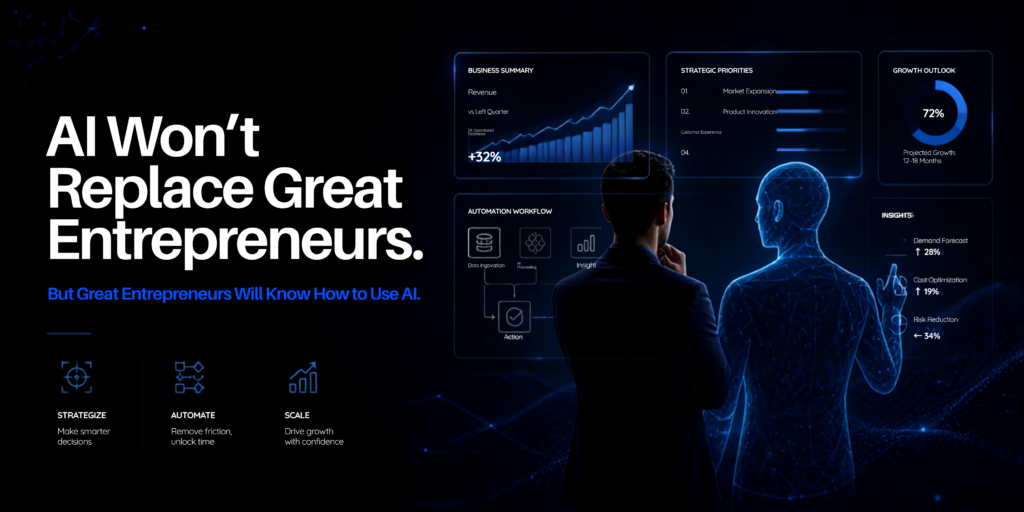
Like every transformative technology before it, AI has the ability to reshape how work gets done. It can process information in seconds, automate repetitive tasks, identify patterns hidden within enormous datasets, and provide insights that would have taken teams days or even weeks to uncover. Those capabilities are remarkable. But they don’t eliminate the need for leadership—they make it even more important.
Technology has never determined the success of an organization on its own. Great businesses are built on vision, trust, accountability, and the ability to make sound decisions when uncertainty exists. AI cannot define purpose. It cannot build a culture. It cannot inspire a team to rally behind a mission that matters. Those responsibilities have always belonged to leaders.
As AI becomes more capable, these uniquely human qualities become even more valuable—not less. The businesses that thrive over the next decade won’t simply be those with the most advanced AI tools. They’ll be the ones led by people who understand how to combine artificial intelligence with human intelligence, strategic judgment, and purposeful leadership. This isn’t another article about prompts or productivity hacks. It’s about understanding why AI is one of the most powerful business partners available today—and why its value depends entirely on the leader guiding it.
Leadership Is Still the Competitive Advantage
One of the biggest misconceptions surrounding AI is that success comes from adopting the latest technology first.
History tells us otherwise.
Every major technological breakthrough—from the internet to cloud computing and smartphones—created opportunities for businesses. Yet simply having access to those innovations never guaranteed success. Companies that flourished weren’t necessarily the first to adopt new technology; they were the ones that knew how to integrate it into a clear strategy.
AI follows the same pattern.
Technology is an amplifier. It magnifies the strengths and weaknesses that already exist within an organization. If your business operates with clarity, disciplined execution, and strong leadership, AI will accelerate those strengths. If your business lacks alignment, accountability, or strategic focus, AI simply helps you reach the wrong destination more efficiently. This is why leadership remains the true competitive advantage. The conversation shouldn’t begin with, “Which AI platform should we invest in?” It should begin with a much more important question:
“How can AI help us become a better business?”
That subtle shift changes everything.
Instead of viewing AI as a replacement for people, great leaders view it as a tool that allows people to focus on higher-value work. Instead of reducing human contribution, they elevate it.
What Great Leaders Do Differently
The most successful leaders don’t measure AI by how many jobs it can replace. They measure it by how much value it helps people create. That mindset fundamentally changes how technology is introduced into an organization.
They automate tasks—not purpose.
Every business has work that consumes time without creating meaningful value. Administrative processes, meeting summaries, scheduling, reporting, documentation, and repetitive analysis are all necessary, but they shouldn’t consume the majority of a team’s energy.
AI excels at handling these responsibilities.
The time that’s created can then be reinvested where people create the greatest impact—building stronger customer relationships, developing innovative ideas, coaching team members, solving complex challenges, and strengthening the business for the future.
They use AI to inform decisions—not replace judgment.
AI can process enormous amounts of information, identify trends, and provide recommendations within seconds.
But leadership has never been about simply having information.
It’s about knowing which information matters.
Context, ethics, experience, emotional intelligence, and long-term thinking remain uniquely human capabilities. Great leaders use AI as an advisor that strengthens decision-making—not as a substitute for accountability.
They build adaptable teams.
Technology changes constantly.
Learning does not.
Organizations that invest only in software eventually fall behind. Organizations that invest in people who know how to learn, adapt, communicate, and lead continue creating value regardless of how technology evolves.
The businesses prepared for the future aren’t those with the newest tools.
They’re the ones with the strongest learning cultures.
What We Can Learn From Industry Leaders
Some of the world’s most successful organizations demonstrate an important truth about AI. They aren’t using it to eliminate leadership.
They’re using it to strengthen it.
Consider Microsoft.
When Microsoft introduced Copilot across its ecosystem, the objective wasn’t to replace employees with artificial intelligence. The goal was to remove repetitive work that distracted employees from more meaningful contributions. Tasks like summarizing meetings, drafting emails, analyzing spreadsheets, and organizing information could now happen in minutes instead of hours. That shift wasn’t about reducing human value—it was about allowing people to spend more time solving problems, collaborating, and innovating.
The lesson isn’t that Microsoft has better AI than everyone else.
The lesson is that Microsoft understands where AI creates value and where people create value.
Shopify offers another powerful example.
CEO Tobi Lütke has encouraged teams to integrate AI into their daily workflows, not because technology is replacing creativity, but because it expands what’s possible. Employees are encouraged to use AI to accelerate research, improve communication, generate ideas, and eliminate repetitive work. The expectation isn’t to depend on AI for answers. It’s to become better thinkers by combining technology with human judgment.
That distinction is important.
AI becomes most valuable when it challenges us to ask better questions—not when it gives us every answer. The financial industry provides another perspective.
JPMorgan Chase processes enormous volumes of financial data every day. AI helps identify fraud, analyze market patterns, improve compliance, and increase operational efficiency. These systems make the organization faster and more informed. Yet no major financial institution places its future entirely in the hands of algorithms.
Critical investment decisions, client relationships, ethical considerations, and strategic planning remain firmly in the hands of experienced professionals. Technology supports the process, but leadership remains responsible for the outcome.
Even the companies building today’s most advanced AI models follow the same philosophy. OpenAI, Anthropic, Google DeepMind, and NVIDIA employ some of the brightest engineers and researchers in the world. Yet despite developing increasingly capable AI systems, these organizations continue investing heavily in human oversight, ethical review, product strategy, and interdisciplinary leadership.
Why?
Because intelligence alone isn’t enough.
Power without direction creates risk.
Innovation without responsibility creates uncertainty.
Technology still requires people to determine how it should be used, what problems it should solve, and what values should guide its development. These organizations understand something every business leader should recognize.
AI doesn’t replace leadership.
It increases the importance of it.
Whether your company has ten employees or ten thousand, the principle remains exactly the same. AI will always reflect the quality of the leadership guiding it. A clear vision produces better outcomes. Strong communication creates better adoption. Healthy cultures adapt more quickly. Leaders who encourage learning help their organizations evolve with confidence instead of fear.
The competitive advantage isn’t having access to AI.
Almost everyone has access.
The advantage is knowing how to lead in a world where everyone has access to the same technology.
Conclusión
The future of business will undoubtedly be shaped by artificial intelligence. New tools will emerge, industries will evolve, and the pace of innovation will continue to accelerate. But while technology changes rapidly, the principles that define exceptional leadership remain remarkably consistent.
Every generation of leaders has faced moments of transformation. Those who succeed aren’t the ones who chase every trend. They’re the ones who understand how to evaluate change, adapt with intention, and stay grounded in timeless principles.
AI is not a strategy. It’s an enabler of strategy. Its greatest value isn’t found in replacing people. It’s found in empowering people to do the work only they can do. When AI handles repetitive tasks, leaders gain the capacity to invest more deeply in their teams, strengthen customer relationships, make better decisions, and build organizations with lasting purpose. That’s where sustainable growth comes from—not from technology alone, but from the people who know how to use it wisely.
The future doesn’t belong to businesses that simply adopt AI. It belongs to businesses that combine technological capability with human wisdom. Because in the end, artificial intelligence may accelerate execution. But leadership will always determine direction.
Throughout this article, we’ve explored why AI is a multiplier, why leadership remains the true competitive advantage, and why the businesses that thrive will be those that combine technology with human judgment.
Now only one question remains: As AI continues to evolve, are you investing just as intentionally in becoming the leader your business will need?