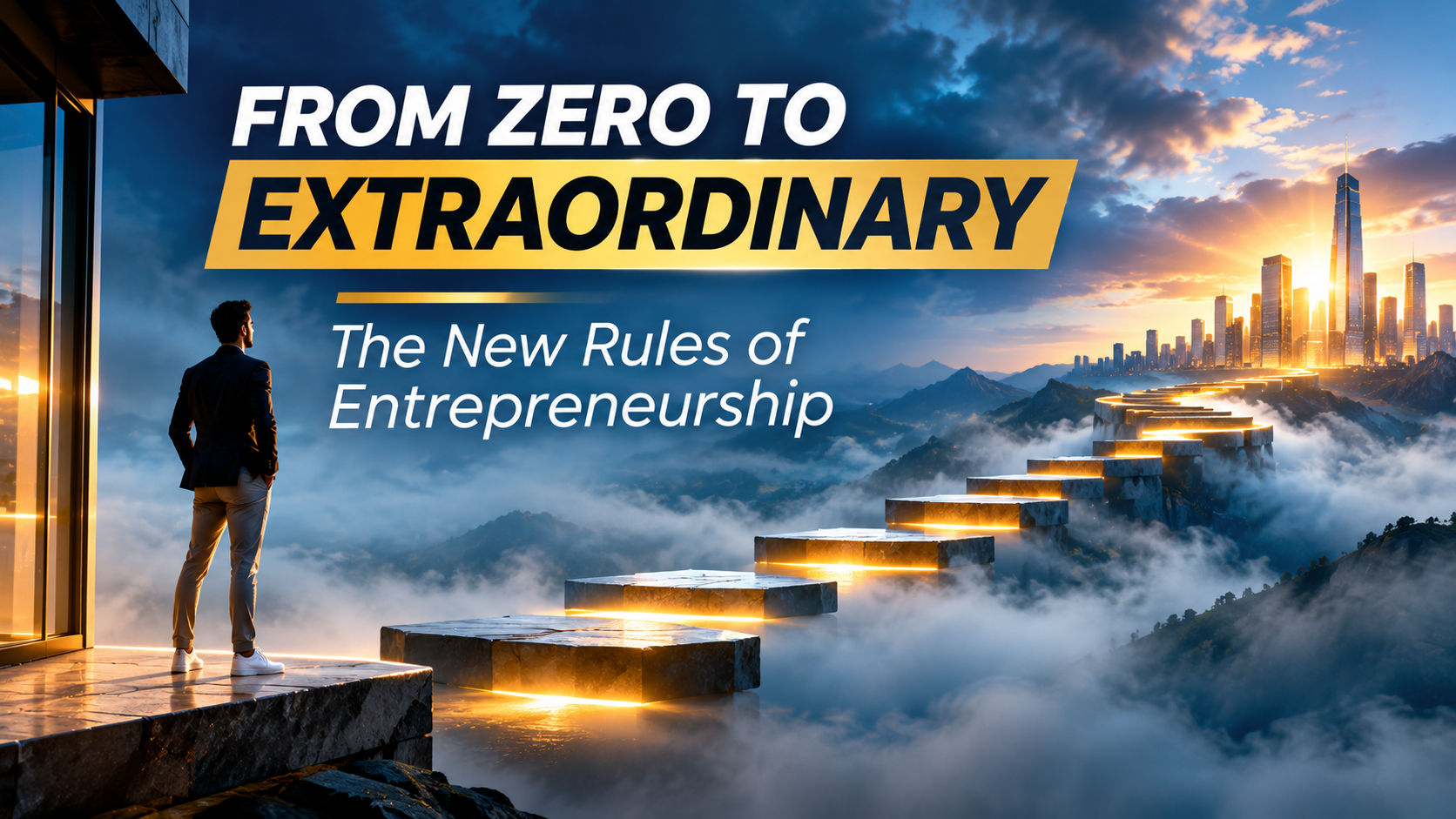
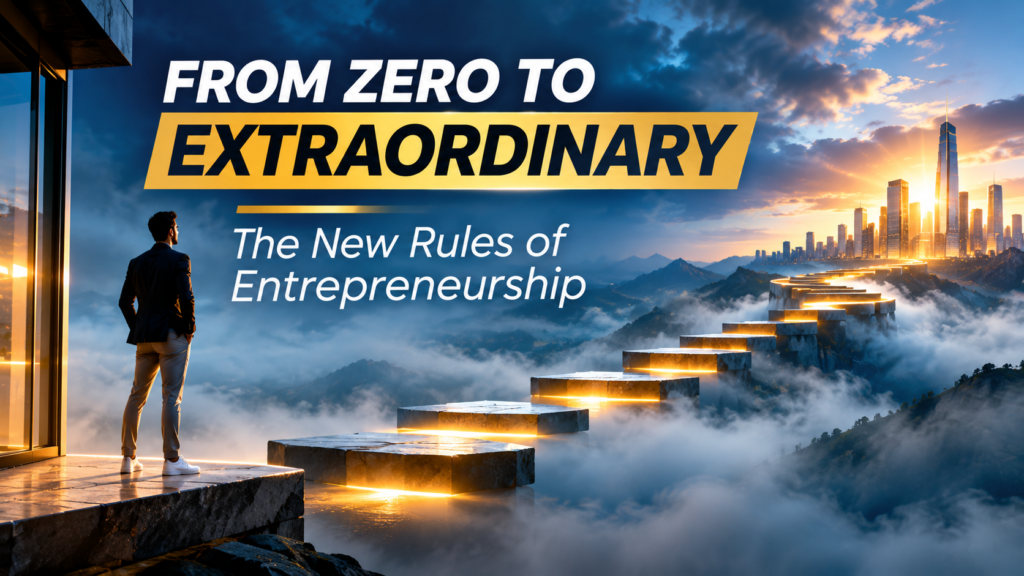
Why the next generation of successful entrepreneurs will be those who learn faster, solve meaningful problems and build businesses that can evolve.
Introduction: Every Great Business Begins With an Uncomfortable Question
Have you ever looked at an ordinary problem and thought, “There must be a better way to do this”?
Perhaps you have struggled to find a reliable local service. Maybe you have noticed that small businesses find digital marketing confusing, that customers waste time comparing products or that a particular community is underserved.
Most people experience these frustrations and move on.
Entrepreneurs do something different.
They begin asking questions.
Why does this problem exist? Who experiences it most frequently? Would people pay for a better solution? Could technology make the process easier? Is there an opportunity to build something valuable around it?
That is where entrepreneurship begins.
Contrary to popular belief, entrepreneurship is not simply about having a brilliant idea, raising investment or becoming the founder of a famous startup.
It is about identifying problems, creating solutions and developing a system that consistently delivers value.
And in today’s rapidly changing world, the rules of building a business are evolving.
Entrepreneurs must think beyond traditional business plans. They need to understand customers, experiment intelligently, use technology, manage uncertainty and build organisations that can survive beyond their initial idea.
The exciting part? You do not necessarily need enormous capital to begin.
You need a problem worth solving, a willingness to learn and the discipline to turn an idea into something people genuinely value.
1. Stop Falling in Love With Your Idea. Fall in Love With the Problem.
One of the biggest mistakes aspiring entrepreneurs make is becoming emotionally attached to their ideas before understanding whether anyone actually needs them.
Imagine someone who wants to launch a premium organic beverage brand.
They spend months selecting packaging, designing a logo, building a website and creating social media accounts.
Everything looks beautiful.
But when the product finally launches, customers show limited interest.
Why?
Perhaps the price is too high. Perhaps customers already have alternatives. Perhaps the product solves a problem that people do not consider important.
The founder has created something they personally like, but has not established that the market wants it.
This is why successful entrepreneurship begins with problem discovery rather than product development.
Before investing heavily in an idea, entrepreneurs should investigate:
- Who experiences the problem?
- How frequently does it occur?
- What solutions are currently available?
- What makes existing solutions inconvenient?
- How much would customers realistically pay for an improvement?
For example, instead of immediately developing an expensive online learning platform, an entrepreneur could interview students, teachers and parents to understand what prevents effective learning.
They may discover that the real problem is not the absence of educational content but the lack of personalised guidance.
That discovery could completely change the business idea.
The strongest entrepreneurs are not necessarily those who defend their original assumptions. They are those who are willing to change their assumptions when evidence suggests a better direction.
2. The New Entrepreneurial Advantage: Starting Small and Learning Fast
There was a time when launching a business often required substantial infrastructure, physical premises, large teams and significant initial investment.
Today, digital tools have reduced many barriers to entry.
A small business can create an online presence, communicate with customers, process payments, analyse performance and reach audiences without building an elaborate physical infrastructure.
This creates an interesting opportunity.
Entrepreneurs can test ideas before committing substantial resources.
Imagine someone considering a personalised gift business.
Instead of renting a shop and purchasing large quantities of inventory, they could begin with a simple catalogue, a social media page and a small collection of sample products.
They could approach potential customers, collect feedback and accept a limited number of orders.
If customers respond positively, the business can expand.
If the response is weak, the entrepreneur can modify the offering without suffering a major financial loss.
This is the logic of experimentation.
A minimum viable product, or MVP, is an early version of a product or service that helps test important assumptions with real users.
It should not be an excuse to deliver poor quality. It should be a focused way of learning what customers value before investing in unnecessary complexity.
The objective is not to launch something perfect.
The objective is to learn what deserves to become perfect.
3. Entrepreneurship Is About Creating Value, Not Just Making Money
Let’s consider two hypothetical businesses.
Business A focuses on selling as many units as possible, regardless of whether customers return.
Business B focuses on solving a recurring customer problem, providing reliable service and building long-term relationships.
Both businesses want to make money.
But their approaches are different.
Business A may experience short-term revenue growth through aggressive selling. Business B may gradually build customer loyalty, referrals and a stronger reputation.
The distinction matters because sustainable entrepreneurship depends on creating value consistently.
A business becomes valuable when customers believe that what they receive is worth more than what they give in return.
That value may be functional, emotional, financial or social.
A food delivery business, for example, may offer convenience. A financial technology company may offer accessibility. An educational startup may offer confidence and career opportunities.
The entrepreneur’s task is to understand which form of value matters most to the target customer.
There is also an important lesson here: profit and purpose do not have to compete.
A business that solves a meaningful problem can create commercial opportunities while contributing positively to society.
The challenge is to design an economically sustainable model rather than relying entirely on goodwill.
4. Technology Is the New Business Partner
Artificial intelligence, automation, cloud computing and digital platforms are changing the entrepreneurial landscape.
For small businesses, these technologies can provide capabilities that were once available mainly to larger organisations.
A founder can use AI tools to organise research, generate initial marketing ideas, summarise customer feedback, automate repetitive administrative work and improve internal workflows.
Consider a small online retailer.
Traditionally, the founder might spend hours answering repeated customer questions about delivery, product availability and returns.
A properly configured support system can handle routine enquiries, leaving human team members available for more complicated customer needs.
Similarly, data analytics can help a small business understand which products sell best, where customers abandon purchases and which marketing campaigns generate meaningful results.
But there is an important warning.
Technology is not a substitute for business understanding.
An entrepreneur who automates a poorly designed process may simply create a faster version of the same problem.
AI-generated marketing content will not automatically create customer trust. An automated customer service system will not compensate for an unreliable product.
Technology should strengthen a sound business model, not disguise a weak one.
The most useful question is not, “Which new technology should I adopt?”
It is, “Which business problem can this technology help me solve better?”
5. Build a Business Model Before Building a Business Empire
Entrepreneurs often become fascinated by growth.
They imagine multiple locations, international expansion, large teams and impressive revenue figures.
Ambition is valuable, but expansion without a sustainable business model can become dangerous.
A business model explains how an organisation creates value, delivers it to customers and earns revenue.
Let’s use a simple example.
Suppose an entrepreneur wants to start a digital marketing agency for small businesses.
Before hiring employees or renting an office, they should understand:
- Which specific businesses will they serve?
- What marketing problem will they solve?
- What services will they provide?
- How will they charge clients?
- What will it cost to deliver the service?
- How will they attract and retain customers?
- What makes their service different?
Perhaps the entrepreneur discovers that local clinics need help building an online presence but cannot afford large agency retainers.
Instead of offering every possible marketing service, the founder could create a focused monthly package covering local search visibility, educational content and basic social media management.
The business becomes easier to explain, price, deliver and improve.
Specialisation can be a powerful competitive advantage, particularly in the early stages.
6. Financial Intelligence: The Skill That Can Save a Great Idea
A surprising number of businesses struggle not because their products are poor, but because they misunderstand money.
Revenue is not profit.
Profit is not cash flow.
And a profitable business can still experience financial trouble if it does not have enough cash available when payments are due.
Imagine a startup that wins a major corporate contract.
The founders celebrate because the deal increases projected revenue.
However, the client pays after 90 days, while salaries, software subscriptions and supplier invoices must be paid every month.
The business may face a cash shortage despite having a profitable contract.
This is why financial management is essential from the beginning.
Entrepreneurs should understand:
Cash flow: How money enters and leaves the business.
Gross margin: How much remains after direct costs associated with delivering products or services.
Customer acquisition cost: How much the business spends to acquire a customer.
Customer lifetime value: The estimated value generated by a customer throughout the relationship.
Break-even point: The sales level at which total revenue covers total costs.
These numbers help founders make decisions based on reality rather than excitement.
A useful habit is to review finances regularly, maintain realistic budgets and prepare for unexpected expenses.
Growth should be supported by financial discipline.
7. Failure Is Expensive. But Not Learning From It Is Even More Expensive.
Entrepreneurial culture sometimes celebrates failure as though it automatically creates wisdom.
It doesn’t.
Failure becomes useful only when an entrepreneur understands why something went wrong and changes their approach.
Suppose a new restaurant introduces a premium subscription programme.
Customers initially show interest, but very few renew after the first month.
Instead of assuming that customers dislike subscriptions, the founder should investigate.
Was the price unreasonable? Were the benefits unclear? Did customers visit frequently enough to justify the fee? Was the redemption process inconvenient?
Each answer suggests a different improvement.
The key is to separate the emotional experience of failure from the analytical process of learning.
Entrepreneurs should conduct regular reviews of experiments, campaigns, products and financial decisions.
A failed experiment is not necessarily a failed business.
Sometimes, it is simply useful information acquired at a relatively low cost.
8. Why Customer Relationships Are More Valuable Than Temporary Attention
In the digital economy, attracting attention is relatively easy compared with retaining trust.
An entrepreneur can create a viral campaign, receive thousands of views and attract a sudden increase in website traffic.
But how many visitors become paying customers? How many return? How many recommend the business?
These are much more meaningful questions.
Customer relationships are built through consistent experiences.
A small business can strengthen them by:
- Delivering what it promises.
- Communicating clearly about pricing and policies.
- Responding honestly when problems occur.
- Asking customers for feedback.
- Improving products based on actual customer needs.
- Providing support after the sale.
Consider a neighbourhood bakery.
It may not have the advertising budget of a national food chain, but it can remember customer preferences, maintain product quality and build personal relationships.
Over time, these small experiences can become a competitive advantage.
The same principle applies to digital businesses.
Personalisation is useful, but it should feel helpful rather than intrusive.
Customers want to feel understood, not constantly monitored.
9. The Entrepreneur of Tomorrow Must Be a Continuous Learner
The skills required to operate a business are changing.
A founder may need to understand marketing one day, negotiate with suppliers the next, analyse financial statements later in the week and evaluate a new technology the following month.
Entrepreneurship demands intellectual flexibility.
No founder knows everything, and pretending otherwise can become costly.
The most effective entrepreneurs build networks of mentors, industry professionals, advisors and peers.
They seek feedback from people who understand different parts of the business.
They also invest in learning about customers, competitors, regulations, technology and changing market conditions.
This is particularly important in emerging markets such as India, where entrepreneurs operate across highly diverse customer groups, regional preferences and levels of digital adoption.
A strategy that works in one city or customer segment may not work in another.
Understanding local behaviour can be just as important as understanding global business trends.
10. Building a Responsible and Sustainable Business
The definition of entrepreneurial success is gradually expanding.
Revenue and profitability remain essential, but businesses are increasingly expected to consider their effects on employees, customers, communities and the environment.
Responsible entrepreneurship does not necessarily require expensive sustainability programmes.
It can begin with practical decisions:
- Reducing unnecessary packaging.
- Avoiding misleading advertising.
- Treating employees fairly.
- Maintaining transparent business practices.
- Supporting local suppliers where appropriate.
- Designing products to reduce waste.
- Protecting customer information.
These decisions can also strengthen reputation and customer relationships.
A business that treats people responsibly may build a more resilient foundation for long-term growth.
The objective is not to appear socially responsible in promotional campaigns. It is to make responsibility part of how the business operates.
11. A Practical Roadmap for Turning an Idea Into a Business
If you are considering starting a business, here is a simple framework.
Step 1: Identify a recurring problem.
Look for frustrations, inefficiencies and unmet needs in a market you understand.
Step 2: Speak to potential customers.
Do not rely entirely on assumptions. Conduct interviews and observe how people currently solve the problem.
Step 3: Design a simple solution.
Develop an initial product or service that addresses the most important customer need.
Step 4: Test willingness to pay.
Positive feedback is encouraging, but actual purchasing behaviour provides stronger evidence.
Step 5: Calculate the economics.
Understand costs, pricing, margins, customer acquisition and cash requirements.
Step 6: Launch on a manageable scale.
Start with a limited market or customer group and learn from real transactions.
Step 7: Improve before expanding.
Identify what works, eliminate unnecessary costs and strengthen the customer experience.
Step 8: Build systems.
Document important processes so that the business does not depend entirely on the founder.
Step 9: Scale responsibly.
Expand only when customer demand, operational capacity and financial resources support growth.
This approach may not look glamorous, but it reduces avoidable risks and creates a more disciplined path towards building a sustainable enterprise.
Conclusion: The Future Doesn’t Belong to Those Who Predict Everything
Entrepreneurship has never been a guaranteed path to success.
Markets change. Customers change. Technology evolves. Competitors appear. Financial assumptions sometimes prove incorrect.
No business plan can predict every possible development.
But entrepreneurs can develop the ability to respond intelligently.
They can learn faster, listen more carefully, experiment more thoughtfully and build stronger relationships with customers.
The next generation of successful entrepreneurs will not necessarily be those who begin with the biggest investments or the most impressive presentations.
They will be those who understand that business is ultimately about people, problems and value.
A good idea may open the door, but execution determines what happens next.
So, if you have been waiting for the perfect moment to begin, perhaps the better question is this:
What small problem can you start solving today?
Because extraordinary businesses rarely begin as extraordinary businesses.
They begin with someone noticing that something could be better—and deciding to do something about it.