Introduction: A Great Business Idea Needs More Than a Great Product
Starting a business has never been easy. You may have a brilliant product, a useful service, a well-designed shop or a team that is passionate about what it does. But there is one challenge every new business must overcome: getting people to know that it exists.
You can offer excellent quality, competitive prices and outstanding customer service, but if potential customers cannot find you, your business will struggle to grow. This is where digital marketing becomes essential.
Think about how people make decisions today. Before visiting a restaurant, they may check its Google reviews. Before buying a product, they may watch a video demonstration or compare prices online. Before contacting a service provider, they may visit the company’s website, look at its social media pages and read customer feedback.
Your potential customers are already using digital platforms to discover, evaluate and choose businesses. If your brand is missing from those spaces, you are making it harder for people to find and trust you.
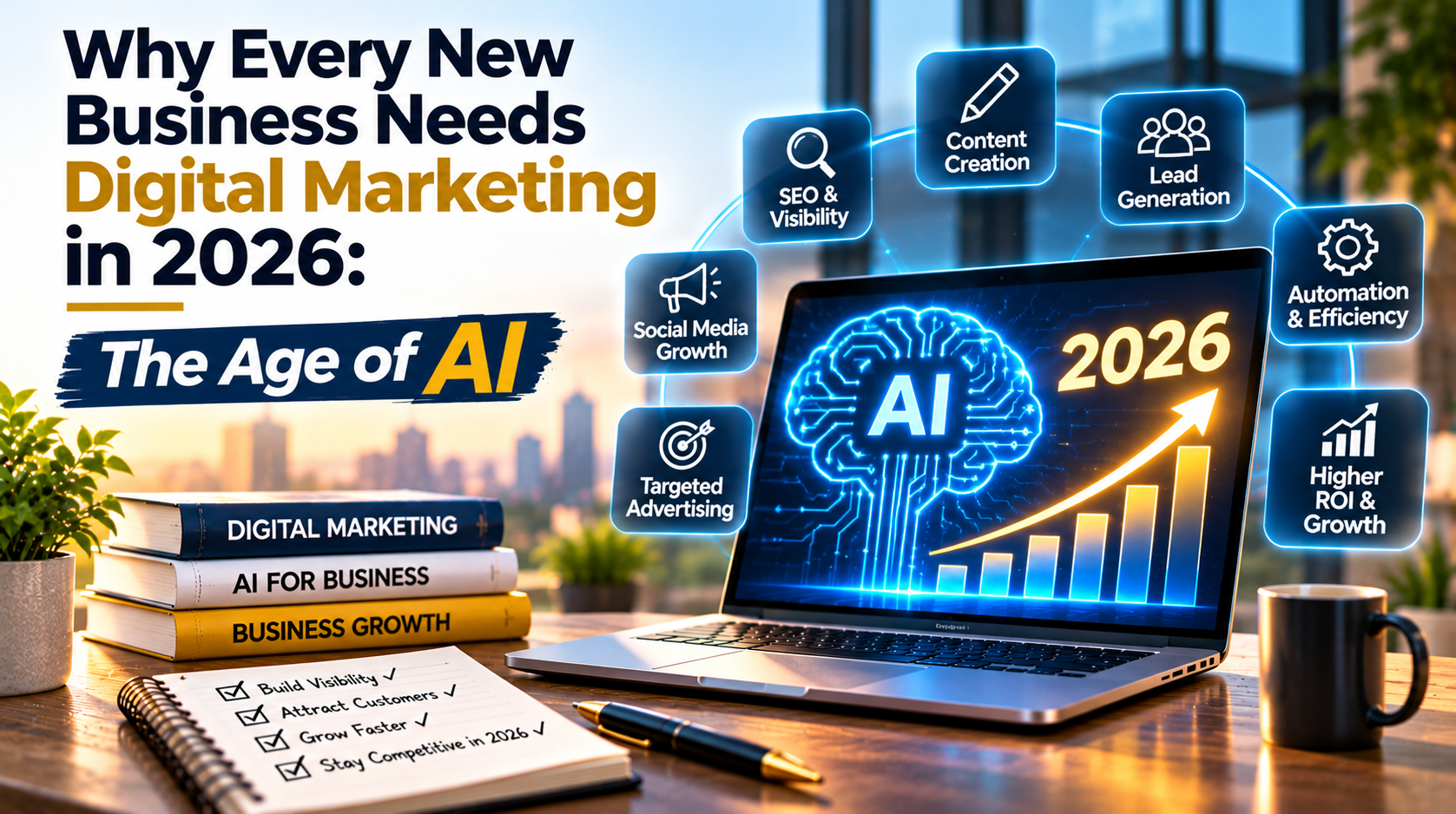
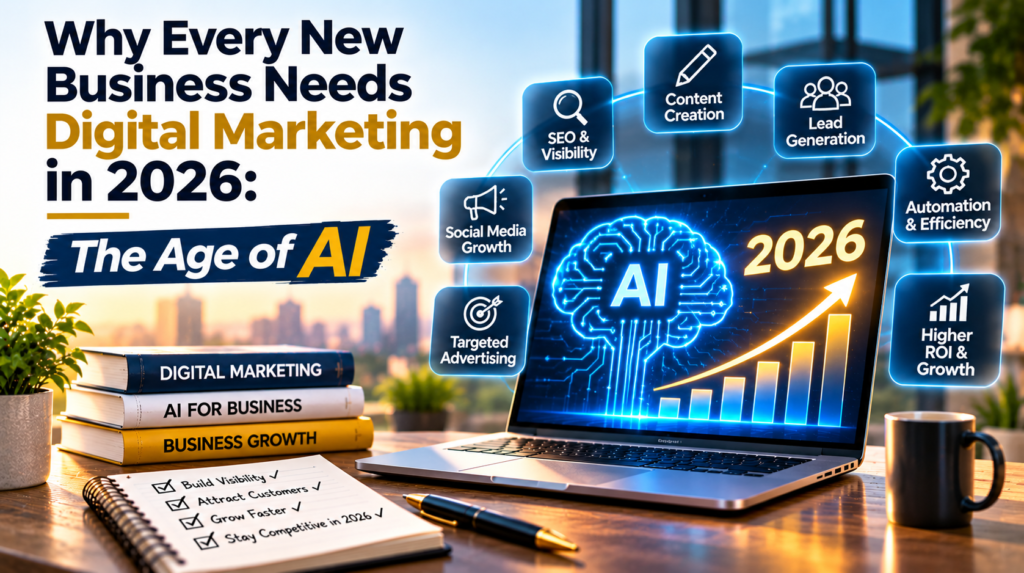
For a new business, digital marketing is not simply an optional promotional activity. It is a way to build visibility, communicate value, understand customers and create opportunities for growth. And in 2026, with artificial intelligence making marketing tools more accessible, even smaller businesses can plan and execute more informed campaigns.
Your Business Cannot Grow If People Cannot Find It
One of the biggest challenges for a new business is visibility. Established companies may already have loyal customers, strong brand recognition and years of word-of-mouth referrals. A new business usually starts without those advantages.
Digital marketing gives you a way to introduce your business to people beyond your immediate circle. A website can explain what you offer. Search engine optimisation can help relevant customers discover your pages. Social media can show the personality behind your brand. Online advertisements can introduce your products and services to audiences who may be interested in them.
Imagine opening a new bakery. The cakes may be delicious, the packaging may be beautiful and the prices may be reasonable. But if people in your neighbourhood do not know the bakery exists, daily sales may remain limited.
Now imagine that you create a Google Business Profile, upload clear photographs, share short videos of your baking process, publish your menu online and encourage satisfied customers to leave honest reviews. Someone searching for a bakery nearby may now have a chance to discover you. Someone browsing Instagram may come across a cake that makes them want to place an order.
You have not changed the quality of your product. You have made it easier for people to discover it.
That is the first major advantage of digital marketing: it helps a new business become visible where potential customers are already spending time. Visibility is not the same as instant success, but without visibility, even a valuable business can remain unknown.
Digital Marketing Helps You Reach the Right Audience
Traditional advertising often involves communicating with a broad audience. A newspaper advertisement, billboard or leaflet may reach many people, but not everyone who sees it will be interested in your product.
Digital marketing gives businesses more ways to make their communication relevant. You can create content for specific customer groups, target advertisements based on suitable audience signals and develop website pages around the services people are searching for.
Suppose you have launched a fitness studio that offers personal training for working professionals. Your most relevant audience may be people living or working within a particular area who are interested in fitness and have the time and budget for your services.
Rather than promoting your studio to everyone, you can create content that addresses the needs of this audience. You might publish a short video about fitting exercise into a busy workday, explain the benefits of personal training or share a realistic beginner’s workout plan.
Your advertising can then focus on the locations and audiences that make commercial sense for your business. This does not mean that every platform can identify a perfect customer automatically. It means you have more opportunities to test and refine who receives your message.
The important point is not to target as many people as possible. It is to reach people who have a genuine reason to care about what you offer. A smaller, relevant audience can be far more valuable than a large audience with little interest in your product.
Your Website Is More Than an Online Visiting Card
A website is often the first serious interaction a potential customer has with a new business. It gives people a place to understand your services, explore your products, check your credibility and contact you.
Yet many businesses treat their websites as one-time design projects. They publish a homepage, add a few photographs and assume the work is complete. In reality, a website should support your business goals.
If you provide professional services, your website should explain the problems you solve, the people you help and how customers can get started. If you sell products, visitors should be able to understand product features, compare options and complete a purchase without unnecessary confusion.
Your website should also be easy to use on mobile devices. Many people discover businesses and browse products on their phones. If your pages load slowly, your text is difficult to read or your contact information is hard to find, potential customers may leave.
A strong website also supports your other marketing activities. Your social media posts can send visitors to it. Your Google advertisements can direct people to relevant service pages. Your email campaigns can link to new products or helpful resources. Search engine optimisation can help your pages appear when people look for information related to your business.
Think of your website as a central place where your marketing efforts come together—not merely a digital brochure. It should make the next step clear, whether that means making a purchase, requesting a quotation, booking an appointment or contacting your team.
Social Media Helps People Connect With Your Brand
For a new business, trust is just as important as visibility. People may hesitate to buy from a company they have never heard of, especially when several competitors offer similar products or services.
Social media gives your business an opportunity to become familiar to potential customers. Through regular, useful and engaging content, you can show what your business does, how it works and what makes it different.
A restaurant can share food preparation videos, customer favourites and behind-the-scenes moments. A clothing brand can demonstrate how to style its products. A consultant can explain common mistakes customers make and offer practical advice. A local service provider can introduce the team, show completed projects and answer frequently asked questions.
The goal should not be to post simply because a content calendar says something must be published. Every post should have a purpose. It may educate, entertain, build trust, answer a question or encourage someone to take action.
It is also important to understand that social media growth takes time. A large follower count does not automatically mean a business is successful. A smaller audience that genuinely trusts your brand and regularly enquires about your services may be much more valuable.
Consistency, relevance and authenticity matter more than chasing every trend. If a particular format is popular but has no connection to your audience or business, you do not need to use it. Focus on content that helps people understand why your business is worth considering.
Search Engine Optimisation Helps Customers Find You Organically
Not every potential customer is going to discover your business through social media. Many people begin with a search engine because they have a question or need a particular service.
Search engine optimisation, commonly known as SEO, helps your website become more useful and discoverable for relevant searches. It involves understanding what your potential customers are looking for and creating website content that genuinely answers their questions.
For example, a new interior design company could publish helpful articles about planning a small apartment, choosing lighting for a living room or understanding the cost of a modular kitchen. These topics connect the business with people who may eventually need interior design services.
SEO is not about repeating the same keyword as many times as possible. Search engines aim to help users find useful information. Your content should therefore be clear, relevant, well-organised and genuinely helpful. Each important page should have a clear purpose and provide information that is useful to the reader.
Local SEO is especially important for businesses that serve a specific area. Accurate business information, a well-maintained Google Business Profile, relevant local pages and genuine customer reviews can help people understand where you operate and what you provide.
SEO usually requires patience. It is not a shortcut to instant traffic. But useful content and a technically sound website can continue attracting relevant visitors over time. This makes it a valuable long-term investment for businesses that want to build visibility without relying entirely on paid advertisements.
Paid Advertising Can Help You Reach Customers Faster
Organic marketing is valuable, but a new business may also need a way to generate attention and enquiries more quickly. This is where paid digital advertising can help.
Platforms such as Google Ads and Meta Ads allow businesses to promote products and services through different advertising formats. Google Search campaigns can help reach people searching for relevant solutions. Facebook and Instagram campaigns can introduce a business to audiences who may be interested in its offerings.
Imagine you have launched a new online store selling handmade home décor. You could use social media advertising to show product photographs, styling ideas and short videos. You could also explore search advertising for relevant product categories if people are actively searching for them.
The key is to begin with a clear objective. Are you trying to generate enquiries, sell products, increase bookings or build awareness? Your campaign structure, creative content and measurement should support that objective.
Paid advertising is not guaranteed growth. Spending more money does not automatically produce more customers. If your offer is unclear, your website is confusing or your follow-up process is slow, you may pay for clicks without generating meaningful business.
Start with a budget you can afford to test, track the actions that matter and use the results to improve your campaigns. It is better to understand why a small campaign is or is not working than to spend heavily without knowing what is happening.
Why Digital Marketing Can Be More Measurable Than Traditional Promotion
One major advantage of digital marketing is the ability to observe how people interact with your campaigns.
You can measure website visits, advertisement clicks, form submissions, phone calls, purchases and other actions. These measurements can help you understand which activities are generating interest and which need improvement.
For example, imagine you run two advertisements for the same service. One generates many clicks but very few enquiries. The other generates fewer clicks but a higher number of qualified leads. If you focus only on traffic, you might choose the first campaign. If you focus on business outcomes, the second may be more valuable.
This is why measurement matters. It helps you move beyond assumptions and make better decisions. You can identify which content attracts visitors, which pages encourage people to contact you and which campaigns generate customers.
However, data must be interpreted carefully. A click is not a sale, a form submission is not necessarily a qualified lead, and a platform’s reported conversion may not tell the whole story. Set up reliable tracking, check the quality of enquiries and connect marketing results to actual business performance wherever possible.
Artificial Intelligence Is Changing the Way New Businesses Market Themselves
Artificial intelligence is one of the biggest developments shaping digital marketing in 2026. Tasks that once required significant time, specialist knowledge or larger teams can now be supported by accessible AI tools.
A small business owner can use AI to brainstorm content ideas, draft social media captions, summarise customer feedback, create campaign variations and organise marketing research. Design tools can help produce visual assets, while analytics and advertising platforms use machine learning to support optimisation and reporting.
This can make marketing more manageable for businesses with limited time and resources.
Imagine you run a small travel company. You could use an AI assistant to generate ideas for destination guides, create a first draft of an email newsletter or organise frequently asked questions from customers. You could then review the information, add your own experience and publish content that reflects your actual services.
AI can also help you repurpose content. A detailed blog post can become several social media ideas, a short video script and an email newsletter. This does not mean publishing the same message everywhere without adapting it. It means using one useful idea as the starting point for different formats.
But AI should support your marketing decisions, not replace your understanding of customers. It can generate an impressive-looking answer that contains inaccurate details. It may also produce generic content that sounds like every other business online.
The strongest approach is to combine AI’s speed with human judgement. Use technology to reduce repetitive work, but keep responsibility for accuracy, brand voice, customer relationships and final decisions.
Why Customer Reviews and Online Reputation Matter
When people discover a new business, they often look for reasons to trust it. Reviews, testimonials, case studies and clear business information can help reduce uncertainty.
A customer who is considering a new restaurant may check recent reviews before visiting. Someone choosing a consultant may look for examples of previous work. A person buying an unfamiliar product may want to see how other customers have experienced it.
This makes your online reputation an important part of digital marketing.
Encourage satisfied customers to share honest feedback. Respond professionally to questions and complaints. Keep your business information accurate. If a customer raises a genuine concern, address it rather than ignoring it.
Do not buy fake reviews or pressure customers into giving misleading feedback. Trust is difficult to build and easy to damage. An authentic reputation is more valuable than an impressive-looking rating that cannot be supported by real customer experiences.
Your reputation also depends on what happens after the first enquiry. If your business responds promptly, explains its services clearly and delivers what it promises, customers are more likely to recommend you. Digital marketing may bring people to your business, but the experience you provide determines whether they stay.
How a New Business Can Build a Practical Digital Marketing Strategy
A new business does not need to be active on every platform from the first day. Trying to manage a website, multiple social media accounts, paid campaigns, email marketing and daily content without a clear plan can quickly become overwhelming.
Begin by understanding your ideal customer. What problem are they trying to solve? What information do they need before making a decision? Where do they search for products or services like yours? What makes them choose one business over another?
Once you understand your audience, create a clear online foundation. Build a useful website, set up the appropriate business profiles and make sure your contact information is consistent. Develop a small number of content themes that explain your expertise, show your products or services and answer common customer questions.
Then choose the channels that match your customer journey. A local service business may prioritise local SEO and Google Search. A visual consumer brand may focus more heavily on Instagram and other visual platforms. A business with a longer sales process may benefit from educational content and email follow-up.
Set a small number of measurable goals. Instead of saying, “We want more online engagement,” define what progress means: more qualified enquiries, more bookings, more online sales or a lower cost per acquisition.
Review your results regularly. Keep what works, improve what does not and avoid changing everything at once. Digital marketing is an ongoing process of learning and refinement.
The Biggest Mistake New Businesses Make: Expecting Instant Results
Digital marketing can create opportunities, but it does not remove the need for patience and consistency.
A website may take time to build search visibility. A social media audience needs a reason to follow and engage. An advertising campaign may require testing before it becomes efficient. Customers may need several interactions with your brand before they feel confident enough to buy.
This is normal.
The mistake is to abandon a strategy too quickly or to keep switching platforms without understanding what is happening. If an advertisement is not generating enquiries, investigate the offer, audience, creative, landing page and follow-up process. If website traffic is low, examine your search visibility and content. If people visit your website but do not enquire, look at the user experience and clarity of your message.
Marketing improves when you treat results as information rather than simply judging a campaign as a success or failure. Give each activity a clear purpose, allow enough time to learn from the results and make changes based on evidence rather than guesswork.
Final Thoughts: Build Your Business Where Your Customers Already Are
In 2026, a new business has more opportunities than ever to reach potential customers, communicate its value and build a recognisable brand. But those opportunities only matter when you use them with a clear purpose.
Digital marketing helps people discover your business, understand what makes it valuable and take the next step. Your website provides information and credibility. Social media builds familiarity. SEO supports long-term discoverability. Paid advertising can create targeted opportunities. AI can help you work more efficiently.
You do not need to do everything at once. You need to understand your customers, choose the right starting points and keep improving based on what you learn.
A great product deserves to be discovered. A valuable service deserves to reach the people who need it. Digital marketing helps bridge that gap.
If you are starting a business, do not wait until you become established to build your online presence. Start with a clear message, a useful digital foundation and a practical marketing plan. Your future customers are already online. Make it easier for them to find you.