Introduction: Where Should Your Business Spend Its Advertising Budget?
Every business wants more customers, more enquiries and more sales. But when you decide to invest in online advertising, one important question often comes up: should you choose Meta Ads or Google Ads?
You may have seen a clothing brand promoting its latest collection on Instagram, while a local service provider appears at the top of Google when someone searches for a particular service. Both businesses are using digital advertising to attract customers, but they are reaching people in very different situations.
Imagine that you own a salon. Someone scrolling through Instagram might come across a makeover video, discover your services and decide to book an appointment. Another person might search Google for “best hair salon near me” because they are already looking for somewhere to visit. Both people could become your customers, but they reached your business through different journeys.
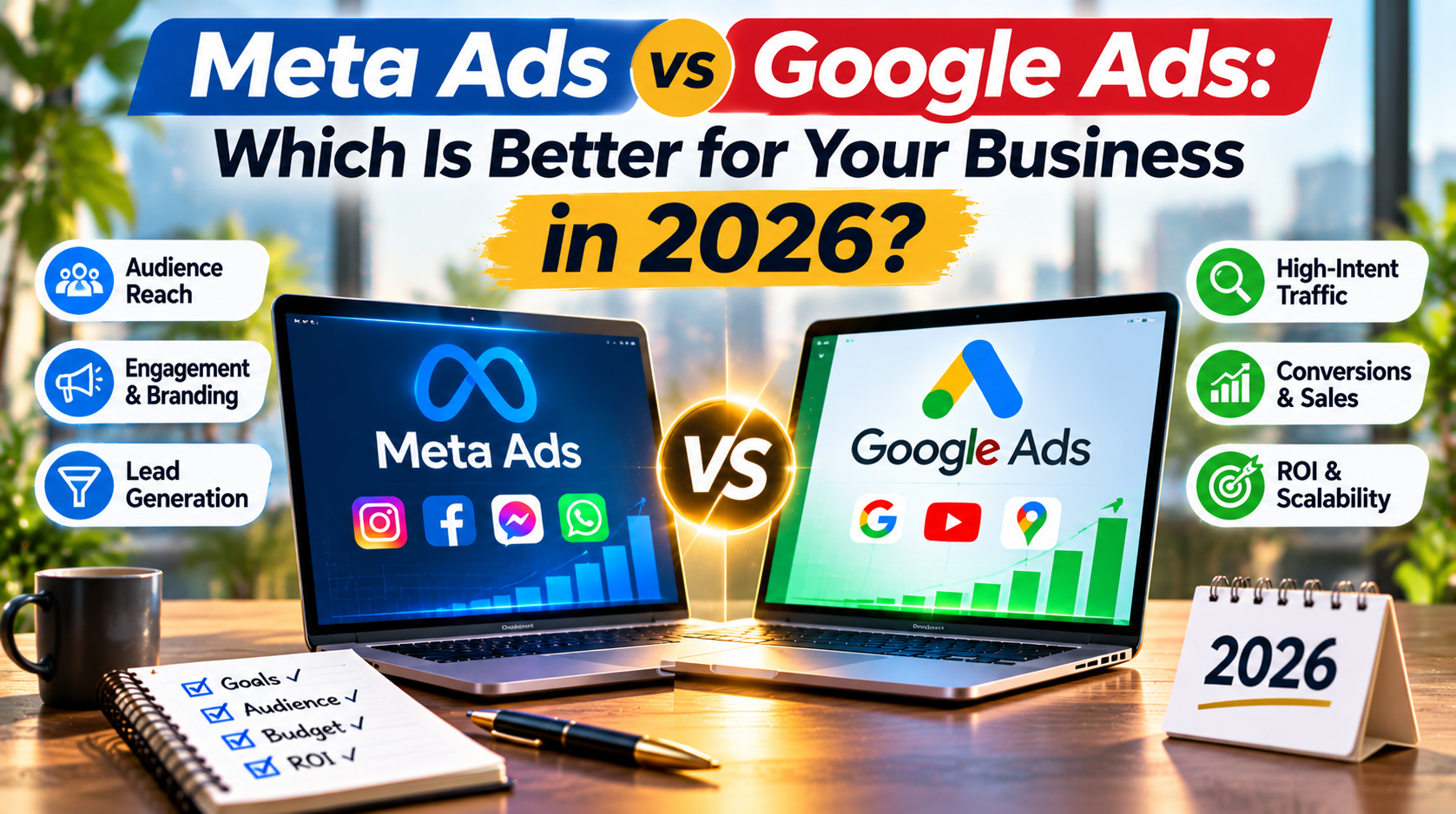
That is the real difference between Meta Ads and Google Ads. Meta can help you introduce your business to people who may not know about it yet. Google can help you reach people who are actively searching for products or services like yours. One can create interest, while the other can capture existing demand.
Neither platform is automatically better. The right choice depends on what you sell, how customers discover your product, how quickly they make decisions and what you want your advertising to achieve. Once you understand these differences, you can make more confident decisions about your marketing budget.
Understanding Meta Ads: Put Your Brand in Front of the Right People
Meta Ads allow businesses to advertise across platforms such as Facebook and Instagram. People use these platforms to watch videos, follow creators, connect with friends, explore interests and discover new products. This gives businesses an opportunity to reach potential customers even when those people are not actively looking to buy something.
Think about a person scrolling through Instagram after work. They may not have planned to purchase new clothes, book a holiday or visit a restaurant. However, an interesting advertisement can introduce an option they had never considered. A well-made video showing a product in use, a customer testimonial or an attractive offer can create enough curiosity for that person to visit a website or contact the business.
This makes Meta Ads particularly useful for products and services that benefit from visual presentation, storytelling and brand discovery. Fashion labels, beauty brands, restaurants, fitness studios, jewellery businesses, travel companies, home décor brands and lifestyle products can use images and videos to communicate their value.
For a new clothing brand, for example, it may not be realistic to expect customers to search for the brand by name. People cannot search for a business they have never heard of. Meta advertising gives the brand a way to introduce its collection to relevant audiences, demonstrate different ways to style its products and encourage people to explore the range.
The biggest opportunity is not simply getting someone to notice an advertisement. It is giving them a reason to remember your business. A strong creative message can communicate your product’s personality, show how it solves a problem and make your brand feel familiar before a customer is ready to buy.
However, attention should not be confused with business results. An advertisement may receive thousands of views and still generate very few sales. Your creative content needs to be supported by a clear offer, a relevant audience, a useful landing page and an easy next step.
Understanding Google Ads: Reach People Who Are Already Searching
Google Ads gives businesses a way to appear across Google’s advertising network. One of its most familiar formats is the Search ad, which can appear when someone searches for a relevant product, service or solution.
Consider your own online behaviour. If your air conditioner stops working, you may search for “AC repair service near me”. If you are planning a holiday, you may look for “family holiday packages from Kolkata”. If you need a professional website, you may search for “website development company”.
These searches tell you something important: the person already has a need. They may be researching possible solutions, comparing providers or preparing to make a purchase. A relevant Google Search campaign can help your business appear at that moment.
This is particularly valuable for businesses that solve specific problems or provide services people actively search for. Consultants, repair services, educational institutions, doctors, real estate businesses, professional service providers and local businesses may all benefit from search advertising when there is sufficient relevant search demand.
Imagine that you operate a plumbing service. A person searching for an emergency plumber is unlikely to be browsing casually. They probably need help soon. If your advertisement appears for a relevant search, communicates that you serve their area and provides a working contact option, you have an opportunity to turn that search into an enquiry.
But appearing on Google does not guarantee that someone will choose you. Your advertisement must match the search, your offer must be competitive and your website must provide the information people need. If a customer clicks an advertisement promising affordable repairs but lands on a page with no clear pricing, service details or contact information, they may leave and choose another provider.
Google Ads can bring relevant visitors to your business. Your website and customer experience must give those visitors a reason to stay.
The Most Important Difference: Creating Demand Versus Capturing Demand
One of the simplest ways to understand Meta Ads and Google Ads is to consider what the customer is thinking when they see your advertisement.
A person scrolling through Instagram may not be planning to buy anything. They are discovering content, watching videos or exploring their interests. Your advertisement can introduce a product or service they did not know they needed. This is often described as demand creation.
A person searching Google for a particular service is usually further along in the buying journey. They may already understand their problem and be comparing providers. Your advertisement can help them find a solution. This is demand capture.
For example, someone who sees a video of a beautiful modular kitchen on Instagram may start imagining a renovation project. They may save the post, follow the business and visit its website later. Another person may search Google for “modular kitchen designers in Kolkata” because they are already planning a renovation.
The first customer may need inspiration and information before making contact. The second may be ready to request a quotation. Both are valuable, but they need different messages.
This is why businesses should avoid judging advertising platforms only by the number of clicks they generate. A Meta campaign may introduce your brand to people who purchase weeks later. A Google campaign may generate fewer visits but attract people who are ready to enquire. The value of each campaign depends on its contribution to the overall customer journey.
Which Platform Is Better for a New or Small Business?
For a small business, the best platform is not necessarily the one with the biggest audience. It is the one that can reach the right people with a message they are ready to act on.
If your business is new and people do not yet know your brand, Meta Ads can help you build awareness, introduce your products and generate initial interest. You can use short videos, product demonstrations, customer experiences and special offers to show people why your business deserves attention.
If people are already searching for the service you provide, Google Ads can help you reach them when their need is clear. A local service provider, for example, may benefit from targeting relevant searches that include the service and location.
Your business model should influence your decision. A new café may benefit from visual content showing its food, ambience and location. A company offering tax consultancy may find that search advertising is useful because customers often look for specific professional services. An online fashion store may use Meta to introduce its products and Google to reach people searching for particular styles or categories.
Your budget matters too. Do not spread a limited budget across several campaigns simply because both platforms are available. Start with one clear business objective and choose the campaign that best supports it. A small, well-planned campaign can teach you more than several poorly managed campaigns running at the same time.
Remember that advertising costs vary by industry, location, competition, audience, creative quality and campaign settings. There is no universal rule that Meta Ads are always cheaper or Google Ads always produce better leads. A low-cost click is not necessarily valuable if it never turns into a customer.
Your Advertisement Can Matter More Than Your Choice of Platform
Businesses sometimes spend too much time debating platforms and too little time improving their actual advertisements. Yet even the most advanced advertising system cannot make an unclear offer attractive.
Imagine two businesses advertising the same service. The first says, “We provide quality digital marketing services.” The second says, “Get a practical digital marketing plan designed to help your local business generate more qualified enquiries.” The second message gives a potential customer a clearer reason to pay attention.
Your advertisement should quickly communicate what you offer, who it helps and why someone should consider it. Strong visuals can attract attention, but the message must create interest and the call to action must make the next step obvious.
For Meta Ads, test different creative approaches. A short demonstration video may work better than a static image. A customer testimonial may build more trust than a promotional graphic. A behind-the-scenes video may help a new business appear more relatable. Do not assume that the most polished advertisement will always perform best. Sometimes a simple, authentic demonstration answers customer questions more effectively.
For Google Ads, focus on the language customers use when searching. Your headlines should connect with their needs, and your landing page should provide the information they expect. If someone searches for a particular service, send them to a relevant service page rather than a generic homepage whenever possible.
The lesson is simple: the advertisement is not just a decoration around your campaign. It is one of the most important parts of the customer experience.
Why Your Landing Page and Follow-Up Process Matter
Getting a click is not the same as getting a customer. After someone clicks your advertisement, they should arrive somewhere that makes it easy to understand your offer and take action.
A good landing page answers the questions a potential customer is likely to have. What exactly do you provide? Who is the service for? What makes your business credible? How can someone contact you? What should they do next?
For a local service business, this may mean showing the service area, phone number, customer reviews and a simple enquiry form. For an online store, it may mean clear product images, pricing, delivery information, return policies and a straightforward checkout process.
The experience should also be consistent. If your advertisement promotes a discount, the landing page should explain that discount clearly. If your advertisement promises a particular service, visitors should not have to search through several pages to find it.
Follow-up is equally important. Someone who fills out an enquiry form may not be ready to buy immediately. If your business responds too late, that person may contact a competitor. A clear process for responding to enquiries, answering questions and following up can improve the value of the advertising you are already paying for.
This is particularly important for businesses that sell higher-value services. A customer may need a consultation, quotation or demonstration before making a decision. Your advertising should lead into a reliable sales process rather than ending when the form is submitted.
Can Meta Ads and Google Ads Work Together?
Yes. In fact, using both platforms can create a stronger marketing strategy when each has a clear role.
Imagine a new interior design company. It uses Instagram to share completed projects, room transformations and design tips. These advertisements help potential customers discover the brand and understand its style. At the same time, the company uses Google Search Ads to reach people looking for interior designers in its service area.
A person may discover the company on Instagram, remember its name and later search for it on Google. Another person may find it directly through a service-related search. Both journeys can lead to an enquiry.
The key is to avoid treating the platforms as completely separate activities. Your website, customer reviews, content and sales process connect them. Meta can introduce your business and nurture interest, while Google can help capture relevant searches. Your website gives people a place to explore your services and make contact.
You can also use remarketing where appropriate and where tracking, consent and platform requirements allow it. This can help you reconnect with people who have previously interacted with your business. However, remarketing should be relevant and respectful. Repeatedly showing the same advertisement to someone who has already purchased or is no longer interested can create a poor experience.
How to Measure Whether Your Advertising Is Actually Working
One of the biggest mistakes in digital advertising is judging success by numbers that look impressive but do not necessarily support business growth.
Impressions tell you how often an advertisement was shown. Clicks tell you how many times people interacted with it. Likes and comments may indicate engagement. These numbers can be useful, but they do not tell you whether the campaign generated profitable customers.
Instead, connect your campaign goals to meaningful business outcomes. If you want enquiries, measure qualified leads and the cost of generating them. If you sell online, track purchases, revenue and the cost of acquiring customers. If you run a local business, measure calls, bookings and actual visits where possible.
A campaign that produces 20 relevant enquiries may be more valuable than one that produces 100 enquiries from people who cannot afford your service or are outside your service area.
Make sure your conversion tracking is configured correctly. Check whether forms, calls and purchases are being recorded accurately. Where possible, compare platform reporting with your own sales records. This helps you understand not only what the advertising platform reports, but what actually happens after a lead reaches your business.
Final Verdict: Choose the Platform That Matches Your Customer’s Behaviour
So, Meta Ads or Google Ads—which one should your business choose in 2026?
Meta Ads can be a powerful choice when you need to introduce your brand, create interest and connect with audiences through visual storytelling. Google Ads can be particularly effective when customers are actively searching for a product or service and are ready to take the next step.
Do not choose a platform simply because another business is using it. Understand how your customers behave, identify where they are most likely to discover or search for your offering, and build your campaign around that behaviour.
Most importantly, remember that advertising is not a substitute for a good product, a clear offer or a reliable customer experience. It helps people discover your business, but what happens after that determines whether they become customers.
The smartest strategy is not about spending the most money. It is about making every part of your marketing work towards a clear business goal. Start with a focused campaign, measure what matters, learn from the results and improve steadily.
Ready to grow your business online? Build an advertising strategy around your customers, test your campaigns carefully and focus on results that matter—not just numbers that look impressive.