Imagine looking back on the past twelve months and realizing you were busy every single day—but your business didn’t grow in the way you expected.
You worked long hours. You answered every email, attended every meeting, solved every problem, and carried the weight of every important decision. From the outside, it looked like commitment. From the inside, it felt like progress. Yet despite all the effort, the business remained dependent on you. Growth slowed, opportunities were delayed, and your team waited for your approval before taking the next step.
This is one of the most common challenges I see when working with entrepreneurs and business leaders. It’s not a lack of ambition or work ethic that holds them back. In fact, the opposite is often true. They’re so committed to the day-to-day demands of the business that they unintentionally neglect the responsibilities that actually create long-term growth.
Somewhere along the way, many leaders begin measuring productivity by how much they accomplish in a day instead of how much they build for tomorrow. They become exceptional operators but rarely have the time—or the space—to think like architects. The result is a business that functions because they’re present, rather than one that’s designed to thrive because of the systems, people, and leadership they’ve intentionally built.
The goal of leadership isn’t to become indispensable. It’s to create a business that becomes increasingly capable, resilient, and scalable because of the decisions you make today.
That shift begins the moment you stop asking, “How can I get more done?” and start asking a far more important question:
“Am I building a business that depends on my effort—or one that benefits from my leadership?”
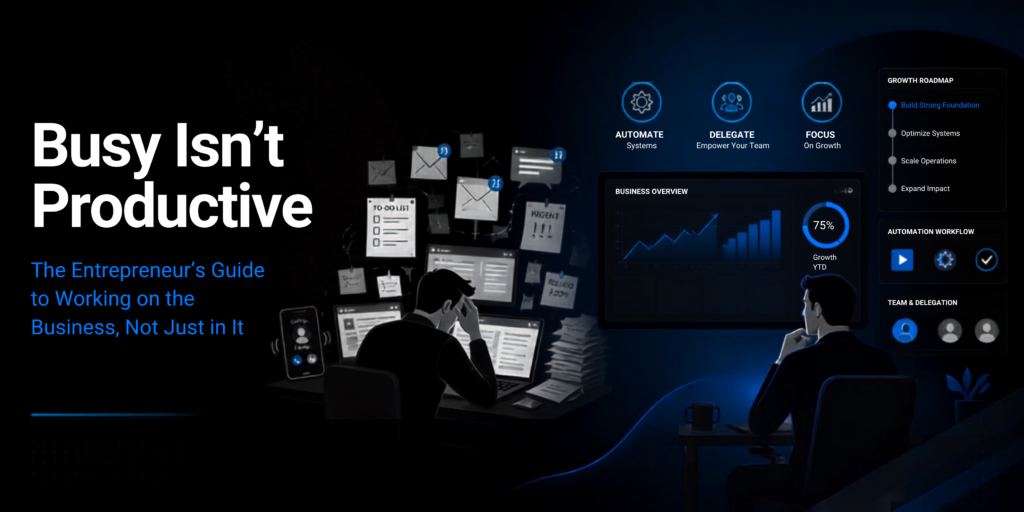
Busy Work vs. Business-Building Work
There is a difference between being involved in your business and creating progress within it.
A full day can be filled with activity—answering emails, joining meetings, reviewing reports, responding to clients, approving decisions, and solving problems as they appear. None of these tasks are necessarily unimportant. The problem is what happens when they consume the time you should be spending on the work only you can do.
As a leader, your highest-value contribution isn’t necessarily completing more tasks. It’s creating clarity, making strategic decisions, developing people, and identifying opportunities that move the business forward.
Consider two business owners who start each Monday with the same workload. One spends the week responding to whatever demands his attention. By Friday, hundreds of tasks may be completed, but the business is largely where it was on Monday. The other deliberately protects time to improve a process, coach a team member, review the company’s direction, or identify a new opportunity. Fewer tasks may have been completed, but something important has changed.
That distinction matters.
Productivity shouldn’t be measured only by how much you accomplish today. It should also be measured by what becomes easier, stronger, or more valuable because of the work you did today.
When every hour is spent maintaining the business, there is little time left to improve it.
The objective isn’t to eliminate operational work. It’s to become intentional about where your involvement creates the greatest value—and where your leadership can create value through others.
Busy keeps the business moving. The right work moves the business forward.
If Everything Needs You, You Haven’t Built a System
One of the clearest signs that a business has become too dependent on its owner is simple: every important decision eventually finds its way back to the owner’s desk.
A team member needs approval. A client has a problem. A process breaks down. Something unusual happens, and suddenly the business is waiting for one person to decide what happens next.
At first, this can feel like leadership. You’re involved, you’re informed, and you’re making sure standards are maintained. But as the business grows, constant involvement becomes a constraint. The more decisions that require you, the less capacity you have to focus on the decisions that actually shape the future.
This is where systems become essential.
A strong system doesn’t eliminate judgment. It creates clarity around how recurring decisions, responsibilities, and processes should be handled. It allows people to understand what is expected, how success is measured, and when they have the authority to act without waiting for permission.
The goal of delegation isn’t simply to give away tasks. It’s to transfer ownership.
That requires more than saying, “Handle this.” It means giving people the context, resources, authority, and accountability necessary to succeed.
If your team can only perform when you’re in the room, you haven’t built a high-performing organization—you’ve built a business that depends on your presence.
The real test of a system is what happens when you’re not there.
A scalable business isn’t one where the leader does more. It’s one where the organization can do more without needing the leader to do everything.
Your Calendar Reveals Your Leadership Priorities
If you want to understand what a leader truly prioritizes, don’t ask them what matters most. Look at their calendar.
Most entrepreneurs will say that strategy, team development, and long-term growth are important. Yet when the week fills up, those priorities are often pushed aside by meetings, urgent requests, operational issues, and tasks that feel too important to delegate.
The problem isn’t always poor time management. Sometimes, it’s a failure to distinguish between what is urgent and what is important.
Urgent work demands attention now. Important work creates value later.
A customer issue may need to be resolved today. But developing the employee who can handle that issue independently could prevent dozens of similar problems in the future. A meeting may require an hour of your time. But an hour spent thinking about where the business needs to be three years from now could influence hundreds of decisions that follow.
This is why leaders need protected time to think, not just time to execute.
Schedule time to review your priorities, evaluate your team, examine your systems, and think beyond the next deadline. Strategic thinking rarely happens by accident. If it isn’t deliberately protected, the demands of the day will always find a way to consume it.
Your calendar is more than a schedule. It is a reflection of where your leadership is actually being invested.
If everything on it is urgent, you may be running the business—but you may not be leading it.
The Shift From Operator to Leader
For many entrepreneurs, the habits that create early success can eventually become the very things that limit growth.
In the beginning, being involved in everything makes sense. You learn the business by doing the work yourself. You understand customers, solve problems quickly, and make decisions without waiting for anyone else. That level of ownership can be a major advantage.
But growth changes the equation.
As the business becomes more complex, the question is no longer, “How much can I personally accomplish?” It becomes, “How much can I enable my organization to accomplish?”
That is the shift from operator to leader.
It requires letting go of the belief that being involved in every decision demonstrates commitment. Sometimes, the opposite is true. Strong leadership means creating enough clarity, capability, and accountability for others to take ownership.
Delegation, therefore, isn’t simply about reducing your workload. It’s about developing people. When you delegate effectively, you create opportunities for your team to think, make decisions, solve problems, and grow. You also create capacity for yourself to focus on strategy, culture, relationships, and the future of the organization.
The transition can be uncomfortable. After all, trusting someone else to do something you once handled yourself means accepting that they may approach it differently.
But leadership isn’t about creating more people who work exactly like you.
It’s about building a team capable of achieving results without needing you at every step.
The goal isn’t to become less involved. It’s to become involved where your leadership matters most.
Measure Productivity by What Continues Without You
Perhaps the most meaningful measure of leadership isn’t how much you accomplish when you’re present. It’s what continues to work when you’re not.
Imagine stepping away from your business for two weeks. No calls. No approvals. No daily decisions. Your team knows their responsibilities, customers continue to receive the same level of service, and important decisions are made without everything coming back to you.
That isn’t a sign that you’re less important to the business. It’s a sign that you’ve built something stronger than your individual effort.
A business becomes scalable when knowledge is shared, responsibilities are clear, systems are reliable, and people are trusted to lead within their roles. Your job isn’t to create dependence on you. It’s to create capability around you.
This also changes how we think about productivity. The question isn’t simply, “What did I get done today?” Ask instead, “What did I build today that will continue creating value tomorrow?”
Maybe it’s a process that eliminates recurring problems. Maybe it’s developing an employee who can take greater ownership. Maybe it’s making a strategic decision that gives the company clearer direction.
Those outcomes may not produce an immediate sense of accomplishment, but they compound.
The strongest leaders don’t measure their value by how much the business needs them. They measure it by how much the business can accomplish because of them.
Stop Being Busy. Start Building.
Being busy isn’t the problem. Building a business that requires you to remain busy forever is.
There will always be emails to answer, problems to solve, meetings to attend, and decisions that require your attention. Leadership isn’t about eliminating those responsibilities. It’s about making sure they don’t consume the time and energy needed to build what comes next.
The real measure of productivity is not how exhausted you are at the end of the day. It’s whether your business is stronger because of the decisions you made, the people you developed, and the systems you built.
So, before asking what else you can add to your to-do list, ask yourself:
What can I build today that will make my business better tomorrow—even when I’m not in the room?
Because the ultimate goal isn’t to become the busiest person in the business.
It’s to become the leader who makes the business capable of growing without depending on you for everything.