Have you ever looked at your business and thought, “We should be further ahead by now”? You have good people. You have customers. You are working harder than ever. Revenue is coming in. And yet, something feels stuck. You keep telling yourself that the next hire will fix it. The next marketing campaign will fix it. The next big client will fix it. Maybe a little more time, a little more effort, or a little more money will finally take the business to the next level. But what if the problem isn’t your market? What if it isn’t your team? What if the biggest limitation in your business is the person looking back at you in the mirror? I know that is not always an easy thing to hear. But sometimes, the business isn’t stuck. The owner is stuck. And when the owner is stuck, the business eventually hits a ceiling.
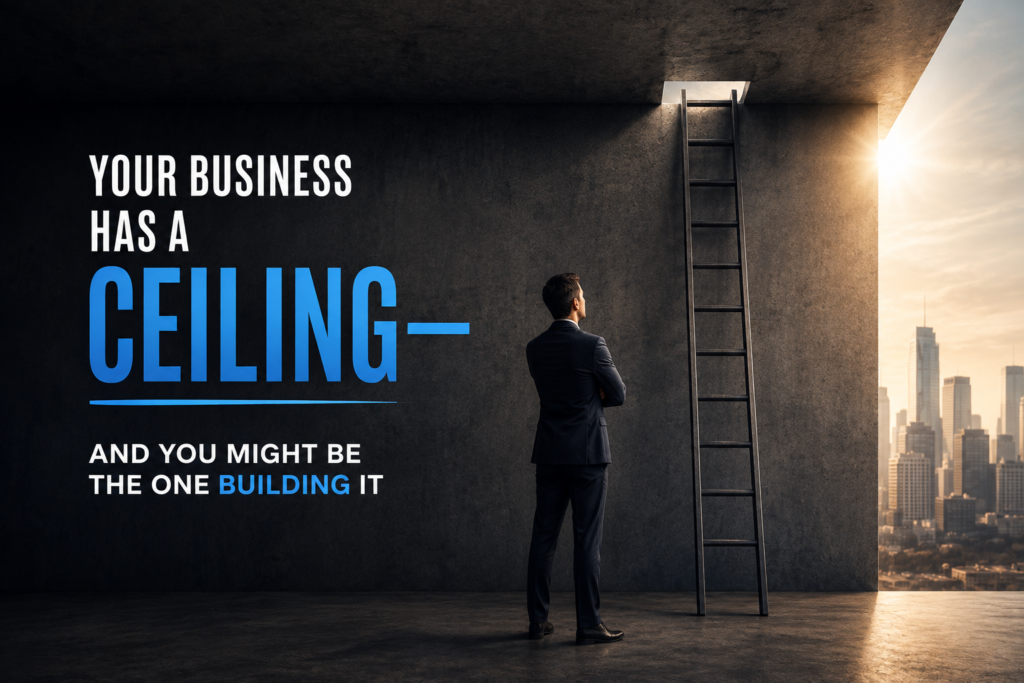
Your Business Isn’t Stuck. You Might Be
Think about the early days of your business. You probably did everything. You answered the phone. You sold the customers. You handled complaints. You made decisions. You checked the numbers. You followed up with employees. You probably even fixed things that had absolutely nothing to do with your job description because, at that stage, you were the business. And that is normal. In the beginning, your ability to personally get things done is an advantage. But eventually, that same strength becomes a weakness. Why? Because the business grows, but your habits don’t. You continue operating like a small business owner when the company needs you to think like a leader building something much bigger. That is where the ceiling starts.
“But Shawn, I have a great team.” I hear this one all the time. And sometimes it is true. You may have incredibly talented people around you. But here is the question I would ask: Do you actually let them lead? There is a big difference between having employees and building leaders. You can have ten people on your team and still be the only person making decisions. You can delegate tasks without delegating ownership. You can tell people what to do without giving them the authority to figure out how to do it. And then one day you look around and say, “Why doesn’t my team take initiative?” Well, maybe they have been trained not to. If every decision has to come back to you, your team eventually learns one thing: “Don’t make the decision. Ask Shawn.” Now imagine doing that 50 times a week. You have created a business where everything depends on you. And that is not leadership. That is a bottleneck.
The dangerous thing about being the bottleneck is that it can feel productive. Your phone is ringing. Your inbox is full. Your calendar is packed. People constantly need you. You are solving problems all day. And at the end of the day, you feel exhausted. So you think, “I worked hard today.” I don’t doubt that you did. But here is the question: Did you work on the business, or did you spend another day keeping the business from falling apart? Those are two very different things. A business owner who spends every day solving small problems may feel essential. But the goal isn’t to become more essential. The goal is to build something that becomes stronger without requiring you to touch everything. That is the difference between owning a business and creating a business that can actually scale.
Let’s make this practical. Can your team make a decision without asking you? Can a salesperson solve a customer problem without calling you? Can an employee handle a mistake without waiting for instructions? Can your operations continue if you take a week off? Can someone explain the company’s priorities without saying, “I need to ask the owner”? If the answer to most of these questions is no, don’t blame your team too quickly. Look at the system you have created. Maybe you have unintentionally taught everyone that your approval is more important than their judgment. That is a hard habit to break. But it can be broken. Start giving people ownership. Not just responsibility. Ownership. Responsibility says, “Complete this task.” Ownership says, “This is your area. Make it better.” That one shift can change the entire culture of a company.
Sometimes business owners try to solve everything with motivation. They gather the team. They give a great speech. They talk about the vision. Everyone leaves excited. For a week, things improve. Then everything goes back to normal. Why? Because motivation without clarity doesn’t last. Your team needs to know what winning looks like. They need clear expectations. They need measurable goals. They need authority. They need feedback. They need accountability. And most importantly, they need to know that their work matters. You don’t build a high-performing team by constantly pushing people. You build one where people understand what they own and have the opportunity to become great at it.
This is another ceiling I see entrepreneurs create. They want to be the person with all the answers. And I understand why. You built the company. You have experience. You’ve made the mistakes. You know the customers. You know the industry. But if you always have to be the smartest person in the room, your team has very little room to grow. Instead, start asking better questions. “What’s your recommendation?” “What would you do if I wasn’t available?” “What do you think we’re missing?” “How would you improve this process?” “What’s the biggest problem in your department right now?” You may be surprised by what you hear. Your employees might have been waiting for permission to think. Give it to them.
Here is something every entrepreneur eventually has to accept: The habits that helped you build the business may not be the habits that help you scale it. Your hustle got you started. But hustle alone won’t build a sustainable company. Your ability to personally control everything helped you survive. But control won’t create freedom. Your willingness to work longer hours helped you get through difficult seasons. But working longer hours isn’t a growth strategy. At some point, you have to evolve. You have to move from doing to leading. From solving to developing. From controlling to trusting. From being involved in everything to being intentional about what deserves your involvement. That transition can feel uncomfortable. Because you may start asking yourself, “If I’m not doing all of this, what am I actually contributing?” The answer is simple. You are building the people, systems, and direction that allow the business to grow. That is your job now.
Another sign that you are the ceiling is when your business runs on what is inside your head. You know how everything works. You know the process. You know what to do when something goes wrong. But nobody else knows. So whenever someone needs an answer, they come to you. That’s not a system. That’s institutional memory trapped inside one person. Start documenting. Create checklists. Write down processes. Record training. Define responsibilities. Create clear standards. Ask your team to document the things they do repeatedly. The goal isn’t to create a mountain of paperwork. The goal is to make the business easier to understand. Because when the knowledge lives in the system instead of only in your head, your company becomes more valuable, more predictable, and more scalable.
If you want to know whether you are the ceiling in your business, ask yourself this: “If I disappeared for 30 days, what would break?” Don’t answer quickly. Think about it. Would sales slow down? Would decisions stop? Would customers complain? Would employees become confused? Would nobody know what to prioritize? Would cash flow become a problem? Would everyone simply wait for you to come back? Your answers will tell you exactly where your business needs work. And that’s good news. Because once you know where the bottleneck is, you can start removing it.
Now, before you misunderstand me, I’m not saying you should make yourself irrelevant. You shouldn’t. Your vision matters. Your leadership matters. Your experience matters. Your relationships matter. Your ability to make important decisions matters. But there is a difference between being valuable and being required for everything. You want to build a company where your involvement creates leverage. Not dependence. You should be spending more time thinking about the future and less time chasing today’s problems. More time developing leaders and less time managing every employee. More time improving systems and less time repeatedly fixing the same issue. More time creating opportunities and less time reacting to emergencies. That is what growth looks like.
So what do you do next? Start small. Pick one area of your business where everything currently depends on you. Maybe it’s sales. Maybe it’s customer service. Maybe it’s operations. Maybe it’s scheduling. Maybe it’s hiring. Ask yourself three questions: What am I doing that someone else could do? What am I doing because nobody has been trained to do it? What decision am I holding onto that someone else is capable of making? Then make one change. Delegate one responsibility. Document one process. Develop one person. Remove yourself from one decision. You don’t have to transform the entire company tomorrow. You just have to stop reinforcing the same ceiling.
The Real Goal: Build Beyond Yourself
Your business doesn’t necessarily need more of you. It may need less dependence on you. That is a difficult shift because entrepreneurs are often rewarded for being the person who gets everything done. But eventually, getting everything done yourself becomes the very thing preventing the company from becoming bigger than you. Your next level may not require another 20-hour workweek. It may require better systems. It may not require another employee. It may require developing the employees you already have. It may not require more control. It may require more trust. And it may not require you to work harder. It may require you to become a different kind of leader. So take a look at your business. Look at the decisions. Look at the systems. Look at your calendar. Look at your team. And be honest. Where are you the bottleneck? Because the moment you stop building the business around yourself is the moment you start building a business that can grow beyond you. And that is the real goal. Don’t build a business that needs you for everything. Build a business that becomes stronger because of you.