Same Situation. Different Perspective. Different Leadership.
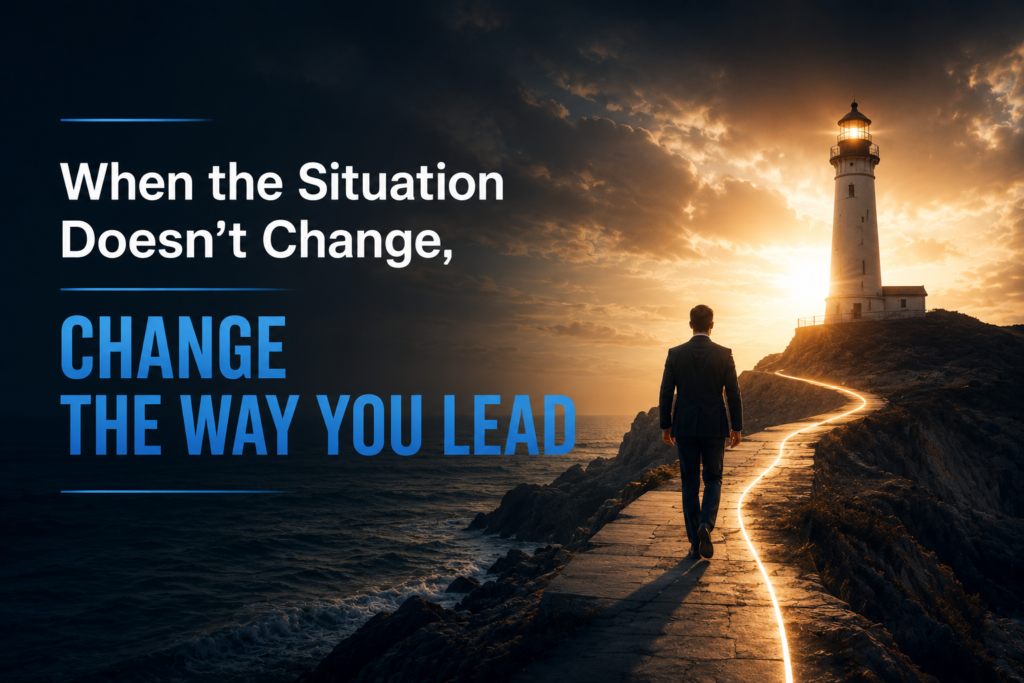
There are moments in business and life when we become convinced that something outside of us needs to change before anything can get better. We want the market to improve, the team to become more accountable, the customer to say yes, the employee to perform better, the business to grow faster, or the circumstances to finally become easier. We tell ourselves that once the situation changes, we will be able to think clearly, make better decisions, lead effectively, and move forward. But what if we have the sequence completely backward? What if, in many situations, the first thing that needs to change isn’t the circumstance at all? What if it is the way we are looking at it?
Carlos Castaneda’s thought, “Things don’t change. You change your way of looking. That’s all,” captures a deceptively powerful idea about perspective, personal development, leadership, and business growth. The world around us does not always respond to our expectations. Markets fluctuate. People behave unpredictably. Businesses experience setbacks. Employees make mistakes. Customers reject offers. Plans fail. Competition changes. None of this is new. What separates a reactive manager from an effective leader, or a struggling entrepreneur from a resilient one, is often not the absence of difficult circumstances, but the ability to interpret those circumstances differently.
Perspective is one of the most underestimated leadership skills. It influences how we communicate, how we make decisions, how we manage conflict, how we respond to failure, how we develop our teams, and ultimately how we build businesses. Two leaders can face the exact same problem and produce completely different outcomes because they don’t see the problem in the same way. One sees an employee who cannot be trusted. Another sees an employee who needs coaching. One entrepreneur sees a failed product launch. Another sees market research that happened to arrive without a research budget. One sees a difficult customer as a nuisance. Another sees an opportunity to understand what the market actually values.
The circumstances may be identical. The interpretation is not.
And that is where real growth begins.
In management, perspective can be the difference between controlling people and leading them. Imagine an employee making the same mistake repeatedly. A manager operating from frustration might immediately conclude that the employee is careless, unmotivated, or simply not good enough. The natural response is to criticize, monitor more closely, or increase pressure. But an effective leader pauses and asks a different question: Why does this mistake keep happening? Perhaps the employee lacks training. Perhaps the process is unclear. Perhaps expectations were never properly communicated. Perhaps the employee is overwhelmed. Perhaps the wrong person is in the wrong role. Or perhaps the manager has mistaken giving instructions for creating understanding. The mistake hasn’t changed. The leader’s perspective has. And that change creates the possibility of a much better solution.
This is why strong leadership is not simply about having answers. It is about learning to ask better questions. A leader who constantly asks, “Who is responsible for this problem?” may create a culture of blame. A leader who asks, “What allowed this problem to happen?” begins looking at systems, processes, communication, training, accountability, and culture. That is the difference between managing symptoms and solving problems. Great management requires the ability to step back from an immediate emotional reaction and examine the larger picture.
The same principle applies to entrepreneurs. Entrepreneurship is filled with situations that challenge your perspective. You launch a product and nobody buys it. You can interpret the experience as failure and decide that your idea was simply bad. Or you can look at it as feedback and ask what the market is telling you. A major client leaves. You can see it as a disaster, or you can use it as an opportunity to identify how dependent your business has become on a single customer. Revenue declines. You can panic about the numbers, or you can investigate whether your offer, sales process, customer experience, pricing, or market positioning needs to evolve.
The event is real. The meaning you attach to the event is where your leadership begins.
Consider someone like Nelson Mandela. His circumstances were extraordinarily difficult. He spent 27 years in prison, yet his eventual leadership was not defined solely by what had been done to him. His perspective allowed him to approach an extraordinarily divided South Africa with a focus on reconciliation and nation-building. His circumstances did not become easy. His response to those circumstances became extraordinary. That distinction matters enormously in leadership. You cannot always control what happens to you, but you can develop the ability to decide what you will do with what happens to you.
Another powerful example is Satya Nadella. When Nadella became CEO of Microsoft, he inherited a company with tremendous resources and global influence, but also a culture that needed renewal. Rather than simply approaching leadership as an exercise in protecting Microsoft’s existing position, he emphasized learning, empathy, collaboration, and a growth mindset. The strategic changes mattered, but so did the cultural perspective behind them. His leadership demonstrated that business transformation often begins with changing how an organization thinks about itself.
That idea is particularly relevant to today’s entrepreneurs and business leaders because growth frequently creates a new set of problems. The systems that worked when a company had five employees may not work when it has fifty. The founder who once needed to make every decision eventually becomes the bottleneck. The sales approach that worked in the beginning may become ineffective as the market matures. The habits that helped someone become successful can eventually become the very habits preventing the next stage of growth.
This is where perspective becomes essential to business growth. Instead of asking, “How can I work harder?” an entrepreneur might ask, “Why does this business require so much of my time?” Instead of asking, “How can I get my team to depend on me more?” the better question may be, “How can I build a team that can make good decisions without me?” Instead of asking, “How can I fit more tasks into my day?” a high-performing leader asks, “Which tasks should not be on my calendar in the first place?”
That shift takes us directly into productivity and high performance. Productivity is often misunderstood as doing more. In reality, effective productivity is about doing what matters. A business owner can work twelve hours every day and still operate inefficiently. If those hours are consumed by unnecessary meetings, constant notifications, repetitive tasks, micromanagement, and decisions that could have been delegated, working longer does not solve the problem. It simply makes the inefficient system more exhausting.
Change the perspective and the strategy changes with it. Instead of asking how to squeeze more into the day, ask what can be eliminated, delegated, automated, systemized, or prioritized. Suddenly productivity is no longer about speed. It becomes about leverage. And for entrepreneurs who want to build scalable businesses, that distinction is critical.
Perspective also has a profound effect on communication, sales, and influence. Consider a salesperson who hears a prospect say, “Your price is too high.” An inexperienced salesperson may immediately hear rejection. An experienced salesperson may hear a question that has not yet been answered: Does the customer understand the value? That change in perspective can completely transform the conversation. Rather than immediately discounting the product, the salesperson can ask what the prospect is comparing it with, what outcome they are trying to achieve, and what would make the investment worthwhile.
The objective is not to manipulate the customer into buying. It is to understand the customer’s perspective well enough to determine whether there is genuinely a valuable solution. In that sense, great salespeople are not simply persuasive. They are curious. They understand that communication becomes more effective when you stop trying to force your viewpoint and start trying to understand someone else’s.
The same principle applies to conflict within teams. When communication breaks down, it is tempting to decide who is right and who is wrong. But leadership often requires a more useful question: What is each person seeing that the other person isn’t? Two employees may disagree because they have different information. A manager and employee may clash because their expectations were never aligned. A leadership team may struggle because everyone is optimizing for a different objective.
Changing your perspective does not mean abandoning standards or avoiding accountability. Quite the opposite. It allows accountability to become more intelligent. You can hold someone responsible for an outcome while still trying to understand the system that produced it. You can have difficult conversations without turning them into personal attacks. You can maintain high standards while creating an environment where people feel safe enough to learn from mistakes.
This is also why self-awareness is such an important part of personal development. Sometimes the biggest obstacle to professional growth is not a lack of knowledge. It is an unquestioned assumption. We assume that because we have always done something a certain way, it must still be the best way. We assume that being busy means being productive. We assume that being in control means being a good leader. We assume that an employee who asks too many questions is difficult rather than curious. We assume that a competitor is a threat rather than a source of market information.
Our assumptions become invisible because we live inside them.
High performers learn to question them.
They develop the discipline to stop and ask, “Is this actually true?” That single question can be transformative. It creates space between the event and the reaction. And within that space lies better decision-making.
This is perhaps the greatest lesson for anyone interested in leadership, entrepreneurship, management, or career growth: you do not need to control everything to influence the outcome. You need to control the way you respond.
When a business fails to hit its target, ask what the numbers are teaching you. When an employee struggles, ask what the situation is revealing about your leadership or systems. When a customer says no, ask what you can learn from the objection. When you feel overwhelmed, ask whether the solution is actually more effort—or better priorities. When growth slows, ask whether your current business model is designed for the next level.
The question changes the lens.
The lens changes the interpretation.
The interpretation changes the decision.
And the decision changes the outcome.
Perhaps this is why the idea behind Castaneda’s quote is so relevant to leadership and business. We spend enormous amounts of energy trying to change things around us. We want different employees, different customers, different markets, different circumstances, different results. But sustainable growth often begins much closer to home.
It begins with the person looking at the situation.
The leader who sees an unmotivated employee may manage through pressure. The leader who sees an opportunity to develop talent may coach. The entrepreneur who sees a failed product may quit. The entrepreneur who sees market feedback may iterate. The manager who sees chaos may micromanage. The manager who sees a systems problem may build better processes. The professional who sees criticism as an attack may become defensive. The professional who sees it as information may become better.
Same world.
Different lens.
Different behavior.
Different outcome.
This doesn’t mean perspective can magically solve every problem. It can’t. Some circumstances genuinely need to change. Some businesses need to restructure. Some employees need to be held accountable. Some strategies need to be abandoned. Some decisions need to be made quickly and decisively. Optimism is not leadership, and positive thinking is not a substitute for action.
But before you change the circumstance, it is worth examining the person interpreting it.
Because your perspective determines the questions you ask. Your questions influence the decisions you make. Your decisions shape your habits, your leadership style, your business strategy, and ultimately your results.
So the next time you find yourself saying, “This isn’t working,” pause.
Ask yourself: What am I not seeing?
The next time you say, “My team isn’t taking ownership,” ask: Have I created an environment where ownership is possible?
When you say, “My business has stopped growing,” ask: What worked before that no longer works now?
When you say, “I don’t have enough time,” ask: What am I continuing to do that I should have stopped doing?
And when you say, “Things need to change,” ask one final question:
“Do they really—or do I need to change the way I look at them?”
Because sometimes the breakthrough isn’t a new strategy.
It isn’t a new employee.
It isn’t a new market.
It isn’t another productivity hack.
Sometimes, the breakthrough is simply seeing the same situation with a better perspective.
Things don’t always change.
Sometimes, you change the way you look at them. And that’s where everything begins.