“AI is everywhere now. But does using AI actually make someone a better marketer?” That’s a question I hear more and more. Everywhere you look, businesses are talking about artificial intelligence. AI can write content, analyze data, generate ideas, personalize customer experiences, create images, automate emails, and support sales teams. It sounds impressive. But there is a bigger question that business owners and marketers need to ask: Are we using AI to become better marketers, or are we simply using AI to produce more content? Because those two things are very different. AI marketing isn’t about handing your entire marketing department over to a machine. It’s about using technology to understand customers better, make smarter decisions, save time, and create more relevant experiences. The marketer still needs to understand people, strategy, positioning, communication, and business goals. AI can make you faster, but strategy makes you effective.
1. Use AI to Understand Customers, Not Just Create Content
Let’s start with one of the biggest mistakes businesses make. They discover an AI tool and immediately ask it to write ten Instagram posts, five emails, three blogs, and twenty advertisements. There’s nothing wrong with using AI for content creation, but if you don’t understand your customer, you can simply produce more content that nobody cares about. Imagine you run a home-repair business. You could ask AI to create social media posts about plumbing, electrical repairs, appliance maintenance, and painting. But a smarter approach would be to first understand what your customers are actually struggling with. Are they worried about technicians arriving late? Are they afraid of being overcharged? Do they struggle to find someone trustworthy? Do they want faster service? Once you understand those problems, AI becomes much more useful. You can use it to organize customer feedback, identify recurring themes, generate messaging ideas, and create content around real customer needs. The lesson is simple: don’t start with “What can AI create?” Start with “What does my customer need?”
2. Let AI Handle the Repetitive Work
Here’s where AI can make a massive difference for marketers. Think about all the repetitive tasks that consume time every week: summarizing customer feedback, organizing research, creating content variations, drafting emails, analyzing campaign results, generating reports, and preparing basic marketing materials. These tasks may be necessary, but they don’t necessarily require your highest level of human thinking. AI can help marketers reduce the time spent on repetitive work so they can spend more time on strategy, creativity, relationships, and decision-making. Imagine a marketer who normally spends three hours organizing customer survey responses. With AI assistance, the initial organization might take minutes. What should the marketer do with the extra time? Not simply create three more hours of content. Use it to talk to customers, study competitors, improve the offer, think about positioning, work with the sales team, and build relationships. The real value of AI isn’t simply doing more work. It’s creating more time for higher-value work.
3. Personalization Is Becoming the New Standard
Remember when getting an email with your name in it felt personalized? Today, that’s barely enough. Customers increasingly expect businesses to understand their interests, preferences, previous interactions, and needs. AI can help businesses analyze customer data and create more personalized experiences at scale. An online store can recommend products based on previous behavior. A SaaS company can personalize onboarding messages. A service business can send reminders based on previous bookings. But there’s an important distinction here. Personalization shouldn’t feel creepy. There’s a difference between making a useful recommendation based on a customer’s previous interaction and making the customer feel like the business is watching everything they do. Good AI marketing should make the customer experience more relevant and useful, not more intrusive. The question isn’t “How much data can we use?” The better question is “How can we use information responsibly to create more value for the customer?”
4. AI Should Support Creativity, Not Replace It
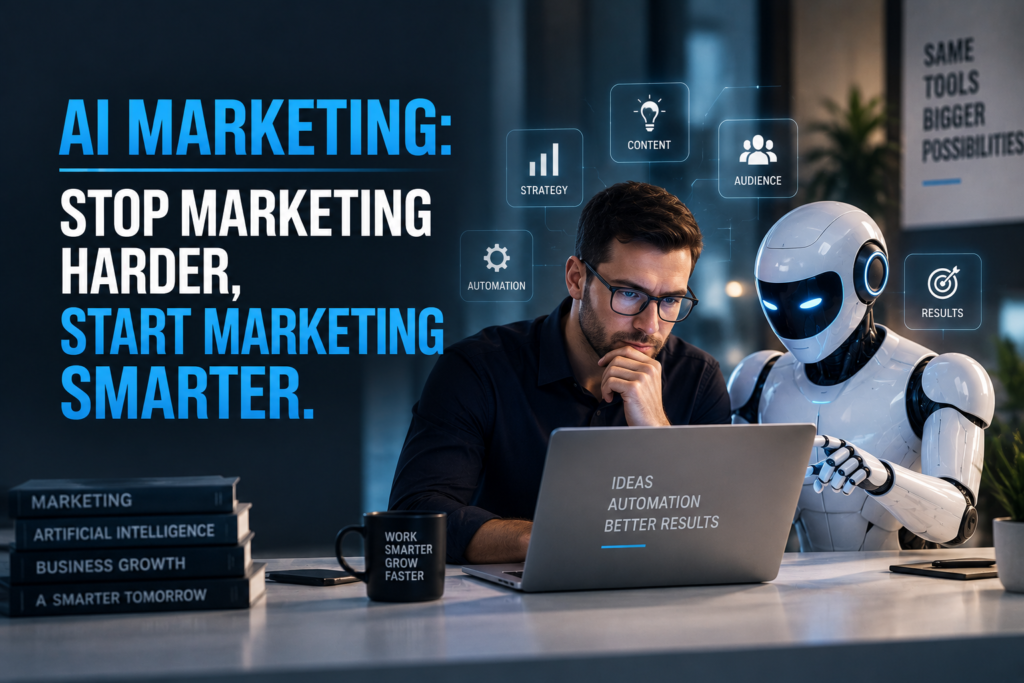
Some people worry that AI will replace creative marketers. I think the bigger opportunity is different. AI can become a creative partner. A marketer can use AI to brainstorm campaign concepts, explore different headlines, generate alternative positioning ideas, challenge assumptions, or turn one idea into multiple formats. But the final judgment still matters. AI might give you twenty headlines, but your job is to know which one actually sounds like your brand. AI can produce a paragraph, but your job is to make sure it sounds human. AI can suggest a campaign, but your job is to understand whether that campaign connects with the market. This is where human creativity becomes even more important. AI can generate possibilities, but humans provide judgment, context, emotion, and meaning. The best marketers won’t compete with AI. They’ll learn how to collaborate with it.
5. Don’t Confuse Automation With Strategy
Here’s another common trap. A business automates everything and assumes it’s now doing great marketing. But automation doesn’t fix a bad strategy. If your positioning is unclear, automation won’t fix it. If your product doesn’t solve a meaningful problem, automation won’t fix it. If your sales message is weak, automation can simply deliver that weak message faster. Think about it like this: if you put a bad message into an AI system and automate it across ten channels, you’ve created a very efficient way to communicate the wrong thing. That’s why marketers need to work from strategy first. Who are we serving? What problem are we solving? Why should customers choose us? What makes us different? What value are we creating? Once those questions are clear, AI can help execute the strategy much faster. Automation should amplify a good strategy, not replace one.
6. Use AI to Make Better Decisions
Marketing has always involved uncertainty. You launch a campaign and hope it works. You test an advertisement. You change the landing page. You adjust the price. You try a different message. AI can help marketers make sense of the information generated by these activities. It can help identify patterns in customer behavior, campaign performance, reviews, and other business data. But there’s something important to remember. AI can help you analyze information. It doesn’t automatically understand your business. A sudden drop in sales could be caused by a competitor, seasonality, pricing, customer experience, economic conditions, or something completely unexpected. The marketer still needs to ask questions and investigate. Think of AI as a powerful assistant sitting beside you. It can say, “Here’s a pattern I found.” You still need to ask, “Why is this happening, and what should we do about it?” That difference separates data-driven marketing from simply having lots of data.
7. Keep the Human Connection
With all the excitement around AI, there’s one thing marketers shouldn’t lose: human connection. Customers don’t want to feel like they’re talking to a machine every time they interact with a company. They want to feel understood. They want businesses to listen. They want problems solved quickly. They want trust. They want someone to take responsibility when something goes wrong. AI can support these experiences, but businesses still need human judgment and empathy. Think about customer service. An AI assistant might answer a common question instantly, and that’s useful. But if a customer has a serious problem, sometimes they don’t want another automated response. They want a person who understands the situation and can take ownership. The smartest businesses won’t ask, “How can we remove humans from the customer journey?” They’ll ask, “Where can AI make the human experience better?” That is a much more powerful question.
8. The Best AI Marketers Will Be Better Thinkers
Ultimately, AI is changing what it means to be a marketer. In the past, marketers often spent a lot of time producing things: writing, designing, researching, reporting, and scheduling. Now AI can assist with many of those activities. So what becomes more valuable? Thinking. Strategy. Creativity. Judgment. Leadership. Customer understanding. Communication. The marketer of the future won’t necessarily be the person who knows how to use the most AI tools. It will be the person who knows which problems are worth solving and how to use AI to solve them better. That’s a completely different skill. You don’t need twenty AI subscriptions. You need clarity about your customer and your business. Start with the problem. Understand the customer. Define the strategy. Then use AI to increase speed, improve execution, and discover opportunities.
Bringing It All Together
AI marketing is not about replacing marketers. It’s about changing how marketers work. The opportunity is enormous, but businesses need to approach it with the right mindset. Don’t use AI simply because everyone else is using it. Don’t create content just because AI makes content creation easy. Don’t automate a process before understanding whether the process is actually valuable. And don’t sacrifice human connection in the pursuit of efficiency.
Instead, use AI to understand your customers more deeply, reduce repetitive work, personalize experiences responsibly, support creativity, analyze information, and make better decisions. The companies that win won’t necessarily be the ones shouting the loudest about AI. They’ll be the ones quietly using it to create better customer experiences, stronger businesses, and more meaningful value.
Because at the end of the day, marketing has never really been about technology. It’s about people. AI is simply giving us a more powerful way to understand, reach, and serve them.
Don’t ask, “How can AI do my marketing?” Ask, “How can AI help me become a better marketer?”
That’s where the real opportunity begins.