Leadership is often associated with confidence, decisiveness, knowledge, and the ability to guide others through uncertainty. We expect leaders to have direction, offer solutions, and make difficult decisions when others are unsure.
But there is another quality that separates effective leaders from those who simply hold positions of authority: the willingness to remain a student, even after becoming the person everyone looks up to.
The strongest leaders understand that their responsibility is not to know everything. It is to create an environment where the best ideas can emerge, the right questions can be asked, and people can continue learning together.
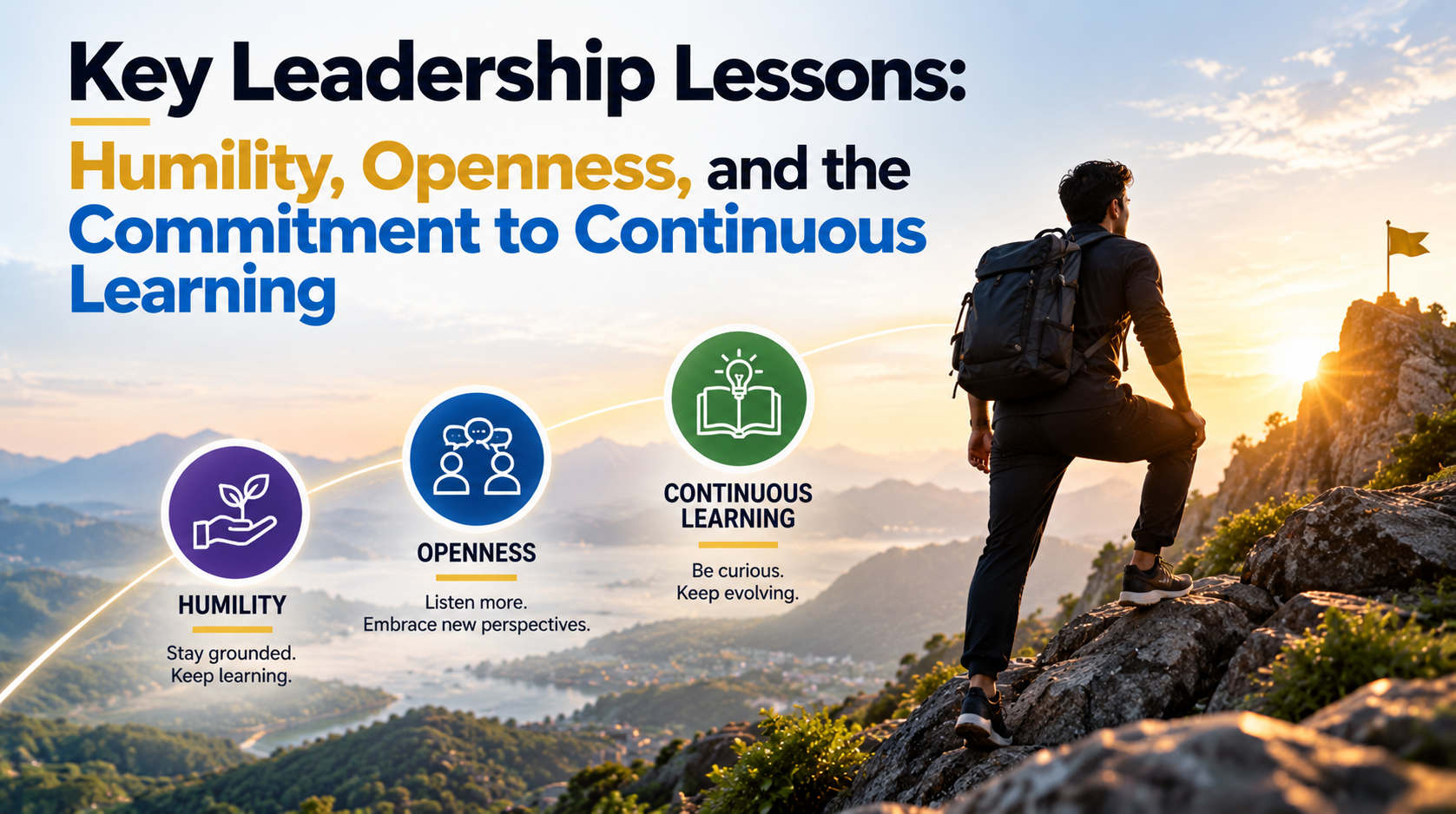
This requires three fundamental qualities: humility, openness, and a commitment to continuous learning.
1. Humility: The Confidence to Admit You Don’t Know Everything
One of the most misunderstood aspects of leadership is humility. It is sometimes mistaken for a lack of confidence, an inability to make decisions, or a reluctance to take responsibility.
In reality, leadership humility is the ability to recognize both your strengths and your limitations without feeling threatened by either.
A humble leader does not underestimate their capabilities. They simply understand that their capabilities are not unlimited.
Consider an entrepreneur who has successfully built a business over several years. Their experience has helped them understand customers, manage finances, negotiate with suppliers, and make strategic decisions. Naturally, they develop confidence in their judgment.
However, the market changes. Customer expectations evolve, new technologies emerge, and competitors introduce different business models.
If the entrepreneur assumes that what worked five years ago will continue to work indefinitely, experience can become a limitation rather than an advantage.
The problem is not experience itself. The problem is treating past success as proof that future decisions must also be correct.
Humility allows leaders to acknowledge that the business environment can change faster than their existing knowledge.
The practical lesson for managers and entrepreneurs: Separate your identity from your ideas.
An idea can be challenged without diminishing your value as a leader. A decision can be corrected without invalidating your experience. And admitting a mistake does not erase your achievements.
Before defending a decision, ask yourself:
- Am I defending this idea because the evidence supports it, or because I do not want to appear wrong?
- What information might change my perspective?
- If someone else presented a stronger solution, would I be willing to adopt it?
These questions create space between your ego and your judgment.
That space is where better decisions begin.
2. Openness: Make It Safe for People to Disagree With You
A leader may genuinely believe in teamwork and collaboration while unintentionally creating an environment where nobody feels comfortable disagreeing.
This often happens through small, repeated behaviours.
A manager interrupts employees before they finish explaining an idea. An entrepreneur dismisses suggestions that challenge an established business strategy. A senior professional responds defensively whenever someone questions their assumptions.
Eventually, people learn to remain silent.
They may continue attending meetings, completing assignments, and following instructions, but they stop contributing their most honest thoughts. Concerns remain unspoken, potential improvements go unexplored, and avoidable mistakes may remain hidden.
The leader might interpret this silence as agreement. In reality, it may simply reflect a lack of psychological safety.
Openness is not about accepting every suggestion or avoiding difficult decisions. It is about ensuring that people can express different perspectives without being punished, embarrassed, or automatically dismissed.
A good leader does not need everyone to agree. A good leader needs everyone to feel able to contribute honestly.
The practical lesson for managers: Invite disagreement before decisions become final.
Instead of asking, “Does everyone agree with this plan?” try asking:
- “What are we overlooking?”
- “What could go wrong with this approach?”
- “If you had to challenge this strategy, what would you question?”
- “What would you do differently if you were responsible for this outcome?”
These questions are more likely to uncover meaningful differences in perspective than a general request for agreement.
Entrepreneurs can apply the same principle when speaking with employees, customers, mentors, and business partners. People closest to the customer or the daily operation may notice problems that are less visible to the person leading the business.
The goal is not to surrender authority. It is to improve the quality of the information available before exercising that authority.
Remember, leadership is not weakened when people challenge your thinking. It is weakened when people stop telling you what they really think.
3. Continuous Learning: Treat Experience as a Teacher, Not a Trophy
Experience is valuable, but experience alone does not guarantee growth.
Two people can spend twenty years in the same profession and develop very different levels of expertise. One continues questioning assumptions, learning new methods, and reflecting on mistakes. The other repeats familiar routines and assumes that longevity is sufficient evidence of competence.
The difference lies in how they use their experience.
Continuous learning requires us to approach professional life with curiosity. It means recognizing that every project, customer interaction, business decision, and difficult conversation can reveal something worth understanding.
For managers, this might involve learning how different employees respond to feedback, discovering better ways to resolve conflict, or understanding how technology is changing the nature of work.
For entrepreneurs, it might involve studying customer behaviour, revisiting pricing decisions, learning from failed experiments, or recognizing that a successful product may require a completely different marketing strategy as the business grows.
The important point is that learning should not be restricted to formal training sessions or professional courses. Much of the most valuable learning happens through everyday work.
The practical lesson: Build reflection into your routine.
At the end of a project or an important decision, ask three questions:
- What worked well, and why?
- What did not work as expected, and what contributed to it?
- What will I do differently next time?
These questions turn experience into insight.
Without reflection, mistakes can become recurring patterns. With reflection, even disappointing outcomes can become valuable sources of information.
Continuous learning also requires the courage to update your beliefs. If new evidence contradicts an assumption you have held for years, the objective should not be to protect the assumption. It should be to understand what the evidence is telling you.
The most effective professionals are not necessarily those who have never been wrong. They are often those who recognize when they are wrong and adapt quickly enough to improve the outcome.
4. Replace the Need to Impress With the Desire to Understand
Many professional conversations quietly become competitions.
People focus on demonstrating expertise, offering immediate solutions, sharing impressive experiences, or proving that they have anticipated every possible problem.
In such environments, listening becomes secondary. Instead of trying to understand another person’s perspective, we listen for opportunities to respond.
This can be particularly damaging for managers and entrepreneurs because both roles depend heavily on understanding people.
A manager who believes they already understand an employee’s motivation may offer advice without first listening to the real concern. An entrepreneur who assumes they know what customers want may invest in a product that solves the wrong problem.
The ability to ask thoughtful questions is therefore not merely a communication skill. It is a business advantage.
Imagine an employee whose performance has declined. A manager focused on demonstrating authority might immediately introduce stricter monitoring or issue a warning.
A manager focused on understanding might begin with a different question: “I’ve noticed that things have been more difficult recently. What is getting in your way?”
The conversation may reveal unclear expectations, conflicting priorities, insufficient resources, or a problem that had never been discussed openly.
The second manager has not abandoned accountability. They have gathered better information before deciding how to respond.
The practical lesson: In your next important conversation, aim to understand before you aim to influence.
Listen without preparing your rebuttal. Ask follow-up questions. Clarify what you have heard. Resist the temptation to turn every discussion into an opportunity to demonstrate your knowledge.
Sometimes, the most useful contribution a leader can make is not the answer they provide but the question that helps someone else discover a better answer.
5. Give Credit Generously and Take Responsibility Personally
A leader’s relationship with recognition reveals a great deal about their mindset.
When a project succeeds, does the leader acknowledge the people whose ideas, effort, and collaboration made the outcome possible? Or does the success become a personal achievement while the team’s contribution fades into the background?
When a project fails, does the leader immediately identify someone to blame? Or do they examine their own decisions, the available resources, and the conditions that influenced the result?
Leaders who need to be the smartest person in the room may also feel the need to be the most visible person in the room.
They may take ownership of successful ideas while distancing themselves from mistakes. Over time, this creates resentment and discourages initiative.
By contrast, leaders who are secure in their own abilities can recognize expertise wherever it appears.
They understand that a junior employee may develop an insight that a senior executive missed. A customer may identify a weakness in a product. A colleague from another department may suggest a solution that transforms an inefficient process.
Recognizing these contributions does not diminish leadership. It demonstrates that leadership is about achieving collective success rather than protecting individual status.
The practical lesson for entrepreneurs and managers: Make recognition specific, visible, and sincere.
Instead of simply saying, “Good job, everyone,” explain what someone contributed and why it mattered. Credit the people responsible for valuable ideas. Encourage team members to present their work and share their expertise.
At the same time, take responsibility when your decisions contribute to a disappointing outcome.
You do not need to accept blame for every problem. You do need to examine your own role honestly.
When leaders consistently give credit and accept appropriate responsibility, they establish a culture in which people can contribute without constantly competing for recognition.
6. Build Teams That Know More Together Than Any Individual Knows Alone
One of the greatest advantages of a team is the diversity of its knowledge and experience.
A finance professional may recognize a financial risk that a marketing specialist overlooks. A customer service employee may understand customer frustrations better than the person who designed the product. A new team member may question a process that experienced employees have accepted without reconsideration.
The value of a team lies partly in these differences.
Yet organizations often fail to benefit from collective intelligence because authority determines whose opinions receive the most attention.
When the most senior person always speaks first, others may adjust their contributions to match the leader’s position. When the leader’s preferred solution is obvious, alternative ideas may never be explored.
Effective leaders deliberately make room for independent thinking.
They may ask team members to submit ideas before a meeting, invite quieter colleagues to contribute, or request an independent assessment before sharing their own opinion.
These simple practices can reduce the influence of hierarchy on discussions and allow a wider range of perspectives to emerge.
For entrepreneurs, this principle becomes particularly important as a business grows. In the early stages, founders often make most decisions themselves because the organization is small and resources are limited. However, the habits that help a founder survive the early stages may eventually restrict the business.
Growth requires the founder to move from being the primary source of answers to building a team capable of finding answers.
The practical lesson: Measure your leadership partly by the quality of thinking your team can produce without you.
Can employees identify problems independently? Can they make sound decisions within their responsibilities? Can they challenge a strategy respectfully? Can they improve a process without waiting for you to notice the problem?
If the answer is yes, you are developing more than a team that follows instructions. You are developing a team that can think.
That is a much stronger foundation for sustainable business growth.
7. Learn to Say, “I Don’t Know Yet”
For some professionals, admitting uncertainty feels like an admission of weakness.
Managers worry that employees may lose confidence in them. Entrepreneurs fear that investors, partners, or customers may question their competence. Experienced professionals may feel that their reputation depends on always having a confident answer.
As a result, they may make assumptions, offer explanations without sufficient evidence, or commit to decisions before they fully understand the problem.
This can create unnecessary risks.
Leadership requires decisiveness, but decisiveness does not mean pretending that uncertainty does not exist.
A responsible leader can acknowledge what is known, identify what remains unclear, and establish a process for finding the answer.
Consider an entrepreneur evaluating a new market. Rather than confidently assuming that demand exists, they can acknowledge the uncertainty and conduct customer interviews, test a small offer, and examine the results before committing substantial resources.
Similarly, a manager facing an unfamiliar technical issue can consult a subject-matter expert rather than making a decision based on incomplete understanding.
The phrase “I don’t know yet” is powerful because it combines intellectual honesty with a commitment to action.
The word “yet” matters. It communicates that uncertainty is not the end of the conversation. It is the starting point for investigation.
The practical lesson: Be transparent about uncertainty, but pair it with a plan.
Say, “I don’t have enough information to make that decision confidently. Let’s identify what we need to know before Friday.”
Or, “I’m not familiar enough with that area to give you a reliable answer. Let’s bring in someone with the relevant expertise.”
This approach builds credibility because it demonstrates sound judgment rather than performative certainty.
People do not need leaders who know everything. They need leaders who know how to respond when they do not.
8. Make Feedback a Tool for Growth, Not a Threat to Identity
Feedback is one of the most valuable sources of professional development, yet it is often difficult to receive.
Even constructive criticism can feel personal when our identity becomes closely tied to our performance.
An entrepreneur may interpret criticism of a product as criticism of their ability. A manager may view feedback about their communication style as a challenge to their authority. A professional who has built a reputation around expertise may struggle to acknowledge that a particular skill needs improvement.
The problem is not necessarily the feedback itself. It is the meaning we attach to it.
When feedback becomes a threat to identity, our attention shifts from learning to self-protection.
We explain why the other person is mistaken. We focus on the tone rather than the substance. We remember the circumstances that justify our actions but overlook the impact they had on others.
Growth requires a different response.
It asks us to separate intention from impact. We may intend to be efficient, for example, while others experience our communication as abrupt. We may intend to maintain high standards while employees experience our expectations as unclear or constantly changing.
Understanding that gap does not mean automatically agreeing with every criticism. It means being willing to investigate whether the feedback contains something useful.
The practical lesson: When receiving feedback, pause before responding.
Ask the other person for a specific example. Clarify the impact of your behaviour. Consider whether the same observation has appeared in previous conversations. Identify one change you can test.
Managers can also normalize feedback by asking their teams questions such as, “What is one thing I could do differently to make your work easier?”
However, asking for feedback is only the first step. The real test is what happens afterward.
If people see that honest feedback leads to thoughtful consideration and appropriate action, they become more likely to share it again.
If they see defensiveness or retaliation, they learn to remain silent.
A leader’s willingness to learn from feedback therefore influences not only their own development but also the learning culture of the entire organization.
9. Turn Mistakes Into Systems Improvements
Mistakes are inevitable in complex work. Decisions are made with incomplete information, assumptions prove incorrect, and unexpected circumstances change the outcome.
What distinguishes a learning organization from a defensive one is how it responds.
A defensive organization focuses primarily on identifying who was responsible. A learning organization also asks what allowed the problem to occur and what can be changed to reduce the likelihood of recurrence.
This distinction matters because individual blame rarely addresses every contributing factor.
A missed deadline, for example, may reflect poor planning. But it may also reveal unrealistic workloads, unclear ownership, late changes in scope, or a process that depends on one person holding all the information.
If the organization simply tells the employee to work harder, the underlying problem may remain.
A leader committed to learning examines both individual responsibility and the system in which the work occurred.
The practical lesson: After significant setbacks, conduct a constructive review.
Ask what the team expected to happen, what actually happened, which assumptions proved incorrect, and what should change next time.
Avoid turning the discussion into either a search for someone to blame or an exercise in avoiding accountability. The objective is to understand the causes and improve future decisions.
For entrepreneurs, this can mean treating unsuccessful marketing campaigns as evidence about customer behaviour rather than simply as wasted money. For managers, it can mean redesigning a process after repeated errors rather than expecting employees to compensate indefinitely for its weaknesses.
A mistake becomes a meaningful learning opportunity only when the insight changes what happens next.
10. Lead by Example: Show People That Learning Never Ends
Perhaps the most powerful leadership lesson is also the simplest: people pay attention to what leaders do, not only to what they say.
A manager may encourage employees to seek feedback while reacting defensively to criticism. An entrepreneur may promote innovation while dismissing unfamiliar ideas. A leader may speak about continuous improvement while refusing to revisit their own established practices.
Such contradictions weaken trust.
If leaders want their teams to remain curious, they must demonstrate curiosity themselves. If they expect people to admit mistakes, they must be willing to acknowledge their own. If they want employees to challenge outdated processes, they must show that their own decisions can be reconsidered.
This does not require leaders to reveal every uncertainty or abandon professional boundaries. It requires consistency between their stated values and everyday behaviour.
A manager who says, “I had not considered that perspective. Let’s explore it,” demonstrates that changing one’s mind can be a sign of good judgment.
An entrepreneur who shares what they learned from a failed experiment demonstrates that setbacks can contribute to progress.
A senior professional who openly credits a younger colleague’s expertise demonstrates that knowledge deserves respect regardless of hierarchy.
These behaviours send a clear message: learning is not something reserved for inexperienced people. It is a responsibility that continues throughout a career.
The practical lesson: Choose one area in which you are willing to be a beginner again.
Learn a new technology. Study a different market. Ask a colleague to explain a process you do not fully understand. Seek a mentor who challenges your assumptions. Attend a discussion where you are not the most experienced person.
The objective is not to collect qualifications or appear intellectually curious. It is to remain capable of adapting when the world changes.
Leaders who continue learning are better positioned to recognize their limitations, make informed decisions, and guide others through uncertainty.
Putting These Lessons Into Practice: A 30-Day Leadership Challenge
Understanding humility and continuous learning is important, but the real value comes from applying these ideas consistently.
For managers and entrepreneurs who want to translate the principles into action, the following 30-day challenge offers a practical starting point.
Week 1: Practise intellectual humility
- Identify one belief or business assumption you have not questioned recently.
- Ask a knowledgeable colleague to challenge your reasoning.
- In your next team discussion, acknowledge one thing you do not know or understand fully.
- Notice when you feel the urge to defend an idea before hearing the complete argument.
Week 2: Create space for other perspectives
- Ask your team to identify one risk in a current plan.
- Invite contributions from people who speak less frequently in meetings.
- Ask a customer, employee, or business partner what you could improve.
- Listen to the response without immediately explaining your intentions.
Week 3: Turn experience into learning
- Review one recent success and one disappointing outcome.
- Identify the assumptions that influenced each decision.
- Write down one lesson you can apply to future work.
- Make one practical change based on what you have learned.
Week 4: Build a culture of learning
- Recognize a colleague whose idea improved an outcome.
- Delegate one decision that someone else is equipped to make.
- Hold a constructive review of a recurring problem.
- Ask your team what would help them learn and perform more effectively.
At the end of the month, reflect on a final question: Have I become more interested in proving my competence, or in improving it?
The purpose of this challenge is not to transform your leadership style overnight. It is to build small habits that make curiosity, openness, and accountability part of your everyday behaviour.
Over time, those habits can influence the quality of decisions, the confidence of your team, and your ability to adapt to new challenges.
Conclusion: The Strongest Leaders Never Stop Being Students
Leadership is not a competition to demonstrate who knows the most. It is a responsibility to help people move toward a shared objective, often in situations where nobody has all the answers.
Humility allows us to recognize our limitations without diminishing our strengths. Openness enables us to consider perspectives that challenge our assumptions. Continuous learning ensures that experience becomes a foundation for improvement rather than a reason to resist change.
For managers, these qualities create opportunities to develop independent thinkers, build trust, and improve team performance.
For entrepreneurs, they make it easier to adapt to changing markets, listen to customers, challenge familiar business models, and build organizations that can grow beyond the founder’s individual capabilities.
And for every professional, they offer a reminder that expertise should never become an excuse to stop asking questions.
You do not have to be the smartest person in every room to make a meaningful contribution. You need to be willing to recognize the intelligence around you, learn from it, and use that collective knowledge to make better decisions.
The next time you enter a meeting, lead a discussion, or make an important business decision, consider changing your objective.
Instead of asking yourself, “How can I demonstrate what I know?” ask, “What can I learn here that will help us do better?”
That small shift can change the way you listen, the way you lead, and the way you grow.
Because the real mark of an effective leader is not the ability to have every answer. It is the humility to keep searching for better ones.
What has taught you more about leadership: the moments when you knew you were right, or the moments when you discovered you were wrong?