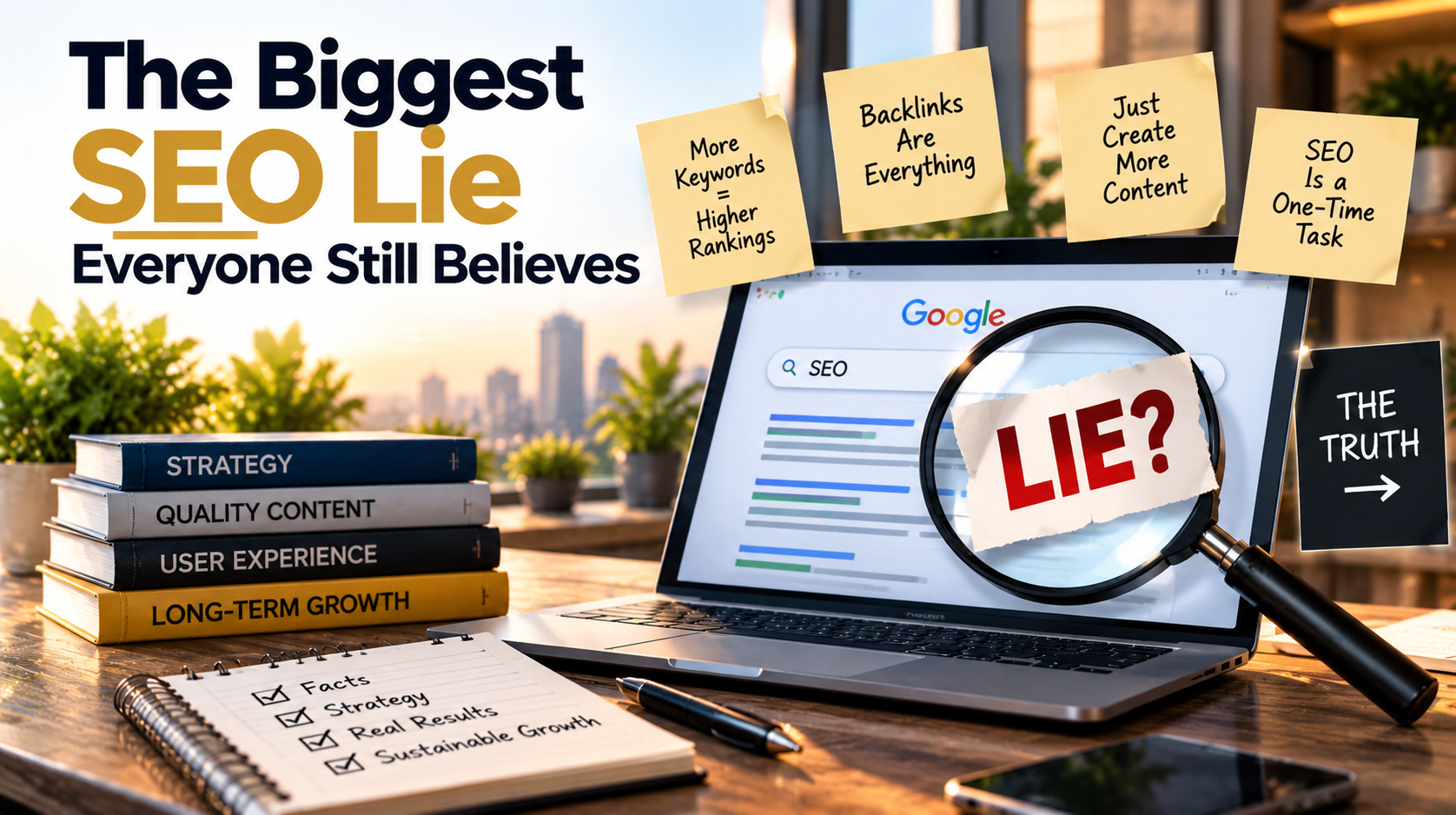
SEO isn’t dead. But the way most people approach it is holding their businesses back.
Let’s be honest. If you’ve ever invested in SEO, you’ve probably heard promises like these:
“Rank on Google’s first page in 30 days.”
“Publish more blogs, and your traffic will skyrocket.”
“Build enough backlinks, and Google will reward you.”
“Follow the right SEO checklist, and rankings are guaranteed.”
Sounds convincing, doesn’t it?
There’s just one problem: SEO doesn’t work like a vending machine. You can’t insert keywords, publish content, collect backlinks, and expect guaranteed rankings in return.
Yet businesses continue to spend thousands on strategies built around these assumptions. They chase rankings instead of revenue, traffic instead of trust, and algorithms instead of audiences.
Meanwhile, their competitors are quietly winning by doing something far less glamorous: understanding their customers, solving real problems, and creating genuinely useful experiences.
So, what is the biggest SEO lie everyone still believes?
It’s the idea that SEO is primarily about pleasing search engines.
It isn’t.
SEO is about making your business the most relevant, useful, and credible answer for the people searching for what you offer.
And once you understand that distinction, everything about your SEO strategy begins to change.
Let’s break it down.
1. The Biggest SEO Lie: More Rankings Automatically Mean More Business
For years, marketers have treated rankings as the ultimate measure of SEO success.
First position? Excellent.
Ten thousand monthly visitors? Even better.
A thousand new clicks? Time to celebrate.
But here’s the uncomfortable question: What if all that traffic never converts into a single customer?
Imagine running a SaaS company that sells project management software to growing businesses. Your SEO agency helps you rank for a high-volume keyword such as “free project management tools.”
Traffic increases. Your analytics dashboard looks impressive. Your monthly report is full of green arrows.
But most visitors are students, freelancers, or people looking for free tools. Your product targets enterprise teams with paid subscriptions.
The result?
Plenty of clicks. Very few qualified leads. Almost no meaningful business growth.
Now imagine ranking lower for a more specific search, such as “project management software for enterprise teams.” The audience is smaller, but its needs align closely with your offering.
Which keyword would you rather own?
The answer should be obvious.
Traffic is an opportunity. Conversions are the outcome.
Rankings and organic clicks matter, but they are intermediate indicators—not the final destination.
A strong SEO strategy connects search visibility to measurable business results, including qualified leads, purchases, demo bookings, and customer lifetime value.
Before chasing a keyword, ask yourself three questions:
- Does this keyword attract my target audience?
- Does the search intent align with what my business offers?
- Can the resulting traffic realistically contribute to a business goal?
If the answer is no, high search volume may be nothing more than an expensive distraction.
2. Google Doesn’t Owe You Rankings for Publishing More Content
Here’s another popular belief: publish consistently, target enough keywords, and Google will eventually reward you.
It sounds logical. More content means more opportunities to rank, right?
Not necessarily.
The internet is already overflowing with articles explaining the same concepts, repeating the same advice, and answering the same questions with slightly different headings.
Search for almost any common marketing topic, and you’ll find hundreds of articles covering identical ground.
Another generic blog post rarely changes the game.
Google’s ranking systems are designed to surface relevant, helpful results. Publishing content simply to increase your page count does not guarantee better visibility.
In fact, creating large volumes of low-value content can waste resources and make it harder to maintain quality across your website.
The real question isn’t, “How many blogs should we publish this month?”
It’s, “What can we publish that genuinely deserves to be read?”
Consider two approaches.
Approach A: Publish 20 articles that repackage information already available across competing websites.
Approach B: Publish five carefully researched articles containing original insights, practical examples, expert commentary, and actionable advice.
Approach B may create a stronger foundation for long-term SEO, even though it produces fewer pages.
The lesson isn’t that publishing frequently is bad. Consistency can help you build topical coverage and serve your audience.
The lesson is that volume without value is a weak strategy.
Before publishing, make sure every piece of content has a clear purpose. Answer a real question. Address a genuine problem. Explain something better than existing resources. Give readers a reason to remember your brand.
Don’t publish to fill a content calendar. Publish to fill a gap in the market.
3. Keywords Matter. Obsessing Over Them Doesn’t.
Keywords remain an important part of SEO. They help you understand what people search for, how they describe their problems, and which topics deserve your attention.
But keyword optimization has often been taken to an absurd extreme.
A marketer identifies a target keyword, inserts it into every heading, repeats it throughout the article, and even squeezes it into sentences where it doesn’t belong.
The result reads less like an expert explaining a subject and more like a robot trying to pass a writing test.
Readers notice. They lose interest. They leave.
And a page that fails to satisfy its audience is unlikely to achieve its full potential.
Modern SEO requires more than matching an exact phrase. It requires understanding search intent—the reason behind a query.
For example, someone searching for “what is email marketing” probably wants a clear explanation.
Someone searching for “best email marketing software for small businesses” is likely comparing solutions.
Someone searching for “Mailchimp pricing” wants specific commercial information.
These searches may belong to the same broad topic, but they represent different needs.
Creating one generic page for all three is unlikely to serve every audience equally well.
Instead, build content around the question the searcher is trying to answer.
Use your primary keyword naturally in important places, such as the title, main heading, URL where appropriate, and relevant body text. Include related terminology when it helps explain the subject.
Then stop counting repetitions and start improving the answer.
The goal is not to make your content look relevant to a keyword. The goal is to make it genuinely relevant to the person searching for it.
4. Backlinks Are Valuable, but They Aren’t a Magic Shortcut
Backlinks have played an important role in Google’s ranking systems for years. Links from relevant, credible websites can help search engines discover pages and understand their importance.
That doesn’t mean every backlink is valuable.
Yet some businesses still approach link building like a numbers game.
Buy hundreds of links. Join questionable directories. Exchange links excessively. Pay for placements on unrelated websites.
Then wonder why their rankings refuse to improve.
The problem is that link quality, context, relevance, and the circumstances surrounding a link all matter. Artificial link schemes can also violate Google’s spam policies and expose a website to ranking consequences.
A hundred irrelevant links are not automatically more useful than a handful of genuine recommendations from respected sources.
Think about how trust works in the real world.
Would you trust a restaurant because a thousand anonymous accounts praised it overnight? Or would you pay more attention to a recommendation from a respected food critic who had actually visited?
Online authority works in a similarly nuanced way.
The best link-building strategies give other websites a legitimate reason to reference your content.
You could publish original research, create a useful industry resource, share expert insights, contribute meaningful commentary, or develop a tool that solves a common problem.
When your work is genuinely useful, earning relevant mentions becomes a more sustainable objective.
Of course, earning links takes time. There are no guarantees.
But that is precisely the point: the strongest SEO assets are earned through value, not manufactured through shortcuts.
5. Technical SEO Is Essential, but It Won’t Rescue Weak Content
Technical SEO is another area where businesses can lose perspective.
They spend weeks discussing Core Web Vitals, canonical tags, XML sitemaps, structured data, crawl budgets, redirects, and indexation.
These are legitimate considerations. Technical issues can prevent search engines from discovering, crawling, understanding, or indexing important pages.
A website that cannot be crawled properly has a fundamental problem.
But technical perfection alone does not make a page worth ranking.
Imagine two websites.
Website A loads quickly, has clean technical architecture, and passes every major technical audit. Its content is generic, outdated, and barely addresses what users want.
Website B is technically sound, provides a better explanation, demonstrates relevant experience, and answers the searcher’s question more effectively.
Website A cannot assume it will win simply because its audit score is higher.
Technical SEO creates the conditions for search visibility. It doesn’t guarantee visibility.
Think of it this way: technical SEO is the foundation of a building. You need it to support everything else. But a perfect foundation doesn’t automatically make the building attractive, useful, or desirable.
A practical technical SEO checklist should cover:
- Crawlability and indexation: Can search engines access and index the pages that matter?
- Site architecture: Can users and search engines navigate the website logically?
- Mobile usability: Does the experience work well on smaller screens?
- Page experience: Are important pages reasonably fast, stable, and responsive?
- Internal linking: Can visitors and search engines discover related content?
- Duplicate URLs and canonicalization: Are search engines receiving clear signals about preferred pages?
Address critical technical problems first. Then invest in content quality, relevance, authority, and conversion optimization.
You need both a functional website and a compelling reason for people to choose it.
6. AI Has Changed Content Creation, Not the Need for Quality
Artificial intelligence has made content production faster than ever.
An idea can become an outline in seconds. An outline can become a draft in minutes. Entire editorial calendars can be generated with a few prompts.
Naturally, some businesses have concluded that publishing hundreds of AI-generated articles is the fastest route to organic growth.
That assumption is risky.
Google’s guidance does not prohibit content simply because AI helped create it. The emphasis is on the quality, usefulness, originality, and purpose of the content—not merely the method used to produce it.
However, using automation primarily to generate large volumes of pages intended to manipulate rankings can violate Google’s scaled content abuse policy.
The distinction matters.
AI can help researchers organize information, writers explore ideas, editors improve clarity, and marketing teams work more efficiently.
But AI-generated text can also contain generic explanations, outdated claims, invented details, and repetitive advice.
Without proper review, a business can publish more content while offering less value.
And when every competitor uses similar tools, producing content is no longer the competitive advantage it once appeared to be.
The advantage comes from what you contribute beyond the draft.
Bring in firsthand experience. Add original data. Interview subject-matter experts. Include real customer questions. Explain trade-offs. Challenge conventional wisdom when evidence supports it.
For example, an AI tool can generate a basic article about reducing customer acquisition costs. An experienced marketer can strengthen it with campaign data, lessons from failed experiments, industry-specific benchmarks, and practical recommendations.
That additional insight makes the content more useful and distinctive.
Use AI to accelerate your expertise, not to manufacture the appearance of it.
7. SEO Is Not a One-Time Project
Another persistent misconception is that SEO works like a website redesign: invest once, complete the checklist, and move on.
Unfortunately, search visibility is not that predictable.
Competitors publish new resources. Search behavior changes. Products evolve. Pages become outdated. Search engine systems change. A once-excellent article may no longer answer the question as effectively as newer alternatives.
Even a well-performing page can lose relevance if nobody maintains it.
That doesn’t mean you need to rewrite every article every month or chase every algorithm update.
It means SEO requires ongoing attention guided by evidence.
Monitor which pages attract qualified traffic. Identify search queries where your content earns impressions but few clicks. Review pages that have lost visibility. Update information that is genuinely outdated. Improve internal links when new content becomes available.
Most importantly, investigate before making changes.
A traffic decline might reflect seasonality, changing demand, stronger competitors, technical problems, or a search engine update. Rewriting the entire website without understanding the cause can make things worse.
Treat SEO as a continuous improvement process, not a collection of tasks you complete once.
The objective is not to keep changing things.
It’s to keep making the website more useful, discoverable, and effective as circumstances change.
8. So, What Actually Works in SEO Today?
If rankings cannot be guaranteed, content volume isn’t a strategy, and shortcuts can backfire, what should businesses do instead?
Build an SEO strategy around five priorities.
1. Understand your audience before targeting keywords
Research what your customers search for, what problems they face, what alternatives they consider, and what information they need before making a decision.
Use keyword research as a starting point—not a substitute for understanding people.
2. Create genuinely useful, intent-focused content
Every important page should have a clear purpose.
Answer the question directly. Organize information logically. Support claims with credible evidence. Include examples and practical guidance. Remove filler that adds length without adding value.
3. Build a technically reliable website
Make sure important pages can be crawled and indexed. Maintain sensible site architecture, effective internal linking, mobile usability, and a strong page experience.
Fix problems that genuinely interfere with discovery or usability rather than chasing perfect audit scores.
4. Earn credibility through expertise and relevance
Demonstrate why your business is qualified to discuss a topic. Showcase real experience, transparent authorship where appropriate, original research, and useful resources.
Build relationships that can lead to legitimate industry mentions and relevant backlinks.
5. Measure outcomes that matter
Track organic visibility and clicks, but go further.
Measure qualified leads, assisted conversions, sales, engagement with important pages, and the contribution of organic search to revenue.
The right metrics depend on your business model. An e-commerce store and a B2B consultancy should not evaluate SEO success in exactly the same way.
The principle remains the same: measure whether your SEO efforts are helping the business achieve its objectives.
When these five priorities work together, SEO becomes more than a race for rankings. It becomes a durable channel for attracting, educating, and converting the right audience.
Final Thoughts: Stop Trying to Trick Google. Start Earning Attention.
The biggest SEO lie is not that keywords don’t matter, backlinks are useless, or technical optimization is unnecessary.
All these elements can matter.
The real lie is the promise that SEO can be reduced to a predictable formula—a checklist that guarantees rankings regardless of the value your website provides.
It can’t.
There is no universal keyword density that guarantees first place. No publishing schedule that automatically produces traffic. No backlink count that assures success. No technical audit score that replaces a compelling user experience.
SEO involves testing, learning, competition, uncertainty, and continuous improvement.
That might sound less exciting than a promise of instant rankings. But it is far more useful when you’re building a business that needs sustainable results.
So, the next time someone promises to take your website to the top of Google, ask a better question.
Not, “How quickly can you get us ranked?”
Ask, “How will this strategy attract the right audience, build trust, and contribute to business growth?”
Because rankings without relevance are vanity. Traffic without intent is noise. And content without value is simply more content.
The businesses that win at SEO aren’t necessarily the ones that publish the most, spend the most, or chase every algorithm update. They’re the ones that consistently give people a better reason to find them, trust them, and choose them.
That is the shift worth making.
And it starts when you stop believing the lie.