Let’s be honest. AI has changed the way we work, and marketing is no exception.
A few years ago, creating a marketing campaign meant hours of brainstorming, researching, writing, designing and planning. Today, with just a few prompts, AI can help you write a blog, create social media posts, generate images, analyse customer behaviour and even suggest an entire marketing strategy.
Sounds amazing, right?
Well, it is.
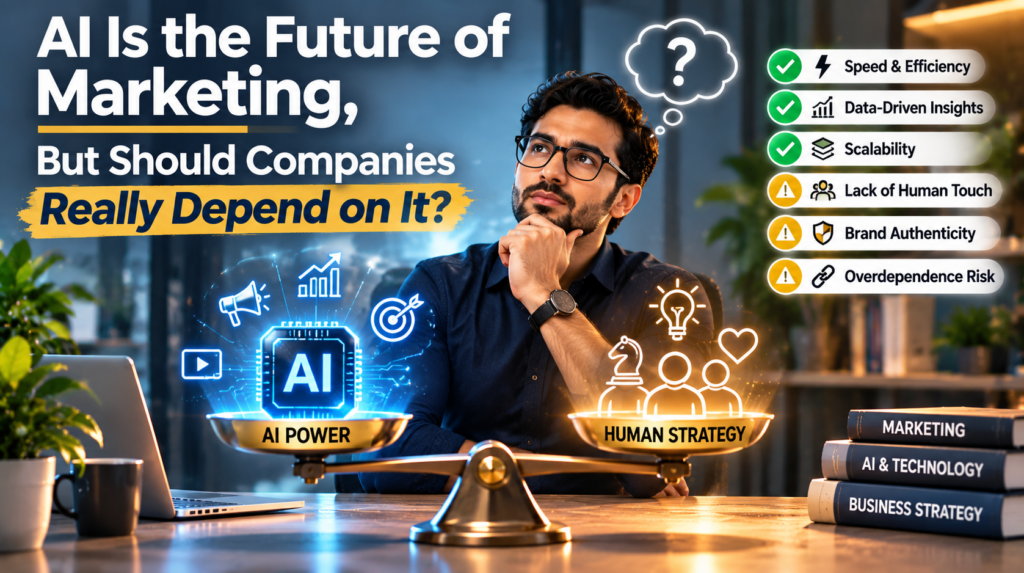
There is no denying that Artificial Intelligence is transforming the marketing industry. Businesses are using it to save time, reduce costs, improve productivity and reach their target audiences more effectively. And if you ask me, companies that completely ignore AI might find it difficult to keep up with the changing business environment.
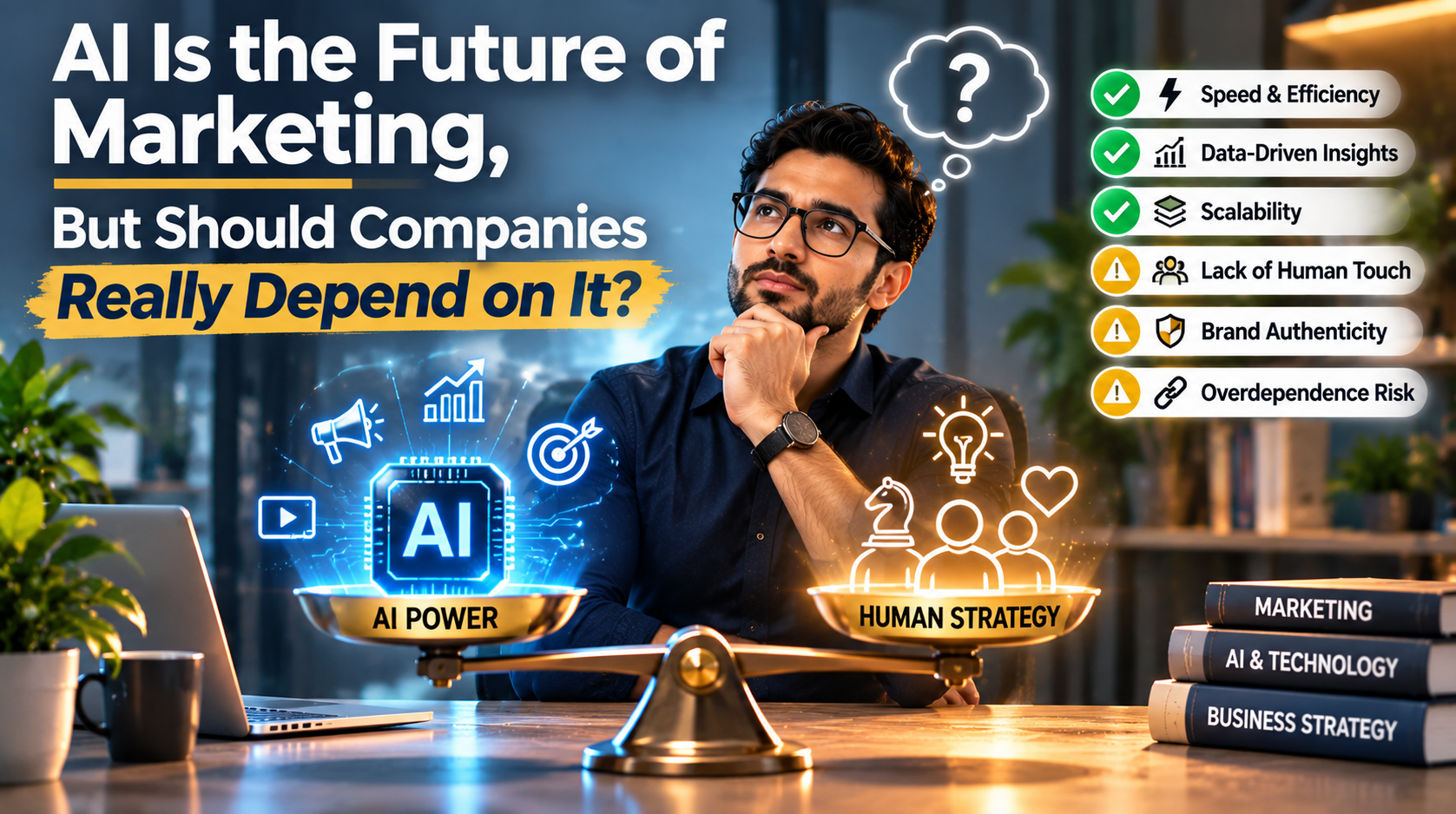
But here is something worth thinking about: Just because AI can do almost everything doesn’t mean a company should depend on it for everything.
Have we become so comfortable with AI that we are slowly forgetting the importance of human creativity, experience and intelligence?
Think about it. If every company starts using the same AI tools to write its blogs, create advertisements, plan campaigns and communicate with customers, what will make one brand different from another?
This is where the real conversation about AI in marketing begins.
1. Can AI Really Understand What Your Customers Feel?
Marketing has always been about understanding people.
Think about your favourite brand. Why do you connect with it? Is it because of its advertisements, the way it communicates, the emotions it creates or the experiences it offers?
More often than not, it is a combination of all these things.
AI can analyse customer behaviour, study purchasing patterns and identify what people are interested in. It can even predict what a customer might want to buy next.
But can it genuinely understand what a customer is feeling?
Imagine a brand launching a campaign during a difficult time. The audience might be going through financial stress, emotional challenges or a sensitive social situation.
AI might generate a perfectly written advertisement, but will it always understand whether the message is appropriate?
Probably not.
Human marketers bring something different to the table. They understand emotions, cultural sensitivities, changing social environments and the little things that influence how people respond to a brand.
Sometimes, successful marketing is not about selling a product. It is about understanding when to speak, what to say and, more importantly, when to remain silent.
And that is something companies should never completely hand over to AI.
2. What Happens When Every Brand Starts Sounding the Same?
Here is an interesting thought.
Imagine ten companies operating in the same industry. All ten decide to use AI to create their website content, social media posts, advertisements and blogs.
What happens next?
There is a possibility that all ten brands start communicating in a very similar way.
The sentences sound familiar. The captions follow similar patterns. The blogs repeat the same information. Even the advertisements begin to look and feel alike.
Now, where is the brand identity in all of this?
Every company spends years building its identity. It works on its communication style, personality, values and positioning to ensure customers recognise and remember it.
But if businesses start relying entirely on AI-generated communication, they risk losing the very individuality that makes them different.
Think about brands that have a distinctive personality. You can often recognise their communication without even seeing their logo.
That is the power of brand identity.
AI can help a company maintain consistency, but it should not decide what makes that company unique.
Your brand should have its own voice, its own opinions and its own personality.
After all, nobody wants to follow a brand that sounds like every other brand on the internet.
3. Is More Content Really Better Content?
One of the biggest advantages of AI is how quickly it can generate content.
Need a blog? AI can help.
Need twenty social media captions? No problem.
Need an email campaign? That can be done too.
But let’s pause for a moment.
Does publishing more content automatically make a company a better brand?
Absolutely not.
The internet is already flooded with information. Customers are constantly scrolling through articles, advertisements, videos and social media posts.
What they actually need is something valuable, interesting and worth their time.
Imagine reading five different blogs about digital marketing. All five cover the same topics, use similar examples and offer almost identical advice.
Would you remember any of them?
Probably not.
The problem is not AI itself. The problem begins when companies use it to produce content without adding their own experiences, research, opinions or expertise.
A company that has spent years working with customers has valuable insights that cannot simply be replaced by generating another generic article.
Use AI to organise your thoughts, improve your writing and save time. But bring your own experiences and perspectives into the conversation.
Because content should not just fill up your website. It should give people a reason to visit it.
4. What If AI Gets Something Wrong?
Now, this is something every business should take seriously.
We often assume that because AI sounds confident, the information it provides must be correct.
But that is not always the case.
AI can make mistakes. It can provide outdated information, misunderstand a question or even generate statistics and facts that are not accurate.
And when a company publishes that information without checking it, the consequences can be serious.
Imagine a healthcare company publishing incorrect information about a treatment.
Or a financial services company sharing misleading investment advice.
Even a small mistake can damage the company’s credibility.
Customers might question the brand’s expertise, competitors might highlight the error, and the company could find itself dealing with negative publicity.
Would you really want your company’s reputation to depend on information that nobody has verified?
Of course not.
This is why human review is so important.
Every important statistic should be checked. Every factual claim should be verified. Every advertisement should be reviewed before it reaches the audience.
AI can help create the content, but someone needs to take responsibility for what gets published.
And that responsibility belongs to the company, not the software.
5. Can AI Replace Human Creativity?
Let’s talk about creativity.
Some of the most memorable marketing campaigns are the ones that make people stop scrolling and think.
They are funny, emotional, unexpected, relatable or sometimes completely unconventional.
What makes them successful is not necessarily how complicated they are. It is the thought behind them.
A creative marketing professional might notice something happening in everyday life and turn it into an interesting campaign.
They might observe a customer interaction, notice a cultural trend or identify an opportunity that nobody else has considered.
That is what makes creativity exciting. It does not always follow a predictable pattern.
AI can certainly help with brainstorming and generating ideas. In fact, it can be an excellent starting point when a marketing team is struggling to think of something new.
But should a company allow AI to make every creative decision?
That is where I believe businesses need to be careful.
If everyone starts depending on AI for ideas, there is a risk that marketing will become increasingly predictable.
We might end up with hundreds of campaigns that are technically good but emotionally forgettable.
Remember, customers don’t always connect with the most perfectly designed advertisement. Sometimes, they connect with the most unexpected one.
And that is why human creativity must remain at the centre of marketing.
6. Can a Chatbot Really Replace a Human Conversation?
We have all interacted with chatbots.
Sometimes they are genuinely helpful. You ask a simple question, get an instant answer and move on with your day.
But what happens when you have a complicated problem?
Imagine ordering something online, receiving the wrong product and trying to get the issue resolved.
You explain the situation, but the chatbot keeps giving you the same automated options.
You try again, rephrase your question and still receive an irrelevant response.
Frustrating, isn’t it?
Now imagine being a customer who has spent a significant amount of money with that company.
Would you feel valued?
Probably not.
This is where companies need to understand the difference between automation and customer satisfaction.
AI chatbots are excellent for handling routine questions, tracking orders and providing basic information. But complicated situations often require human understanding.
Sometimes customers simply want someone to listen, acknowledge the problem and take responsibility.
That human interaction can make a huge difference to how customers perceive a brand.
Technology should make customer service easier, not make customers feel like they are talking to a wall.
7. Are Companies Thinking Enough About Data Privacy?
Here is another important concern.
AI-powered marketing often involves collecting and analysing customer information.
Companies use this information to understand purchasing habits, personalise advertisements and develop targeted campaigns.
While this can improve marketing performance, it also creates responsibilities.
Customers trust companies with their personal information. They expect businesses to handle it carefully and responsibly.
But what happens when employees start uploading confidential customer information into AI tools without understanding how that information is processed?
That is a risk businesses cannot afford to ignore.
Companies need to ask important questions.
Where is the information going? Who has access to it? Is customer consent required? Are employees following the company’s data protection policies?
These are not simply technical questions. They are business responsibilities.
A company can spend millions building its reputation, but one serious data privacy incident can damage customer trust.
So yes, use AI to understand your customers better, but never forget that protecting their information is just as important as understanding their behaviour.
8. What Happens to Human Skills When Everyone Depends on AI?
This is probably one of the most overlooked concerns.
Think about someone who has just started working in marketing.
They need to learn how to write, research, communicate, understand customers, develop ideas and build strategies.
Now imagine that every time they receive a task, they immediately turn to AI.
They ask it to write the blog, create the campaign, suggest the strategy and prepare the presentation.
The work gets completed, but are they actually developing their skills?
Over time, there is a possibility that employees become so dependent on AI that they struggle to complete even basic tasks independently.
This should concern companies.
AI should help employees become better at what they do. It should not become a substitute for learning and professional development.
Businesses need people who can think independently, question information, identify opportunities and make decisions.
After all, what happens when the AI tool is unavailable, produces incorrect information or simply cannot understand a particular business situation?
Employees should have the knowledge and confidence to take over.
A good company does not just invest in technology. It invests in people.
9. So, Should Companies Stop Using AI?
Not at all!
In fact, that would be the wrong conclusion.
AI is here to stay, and its role in marketing will only become more significant.
Companies should absolutely explore its potential.
Use it to analyse customer data, automate repetitive tasks, generate content ideas, improve campaign performance and make everyday marketing activities more efficient.
There is no reason to spend five hours completing a task that AI can help you finish in one.
But there is a difference between using a tool and allowing that tool to control your entire business.
The smarter approach is to understand where AI adds value and where human involvement makes a difference.
For example:
- Content creation: Let AI assist with research and drafting, but let humans bring originality, experience and personality.
- Social media: Use AI for scheduling and performance analysis, but let humans manage conversations and understand the audience.
- Advertising: Use AI to analyse campaign performance, but let creative professionals develop the campaign’s direction.
- Customer service: Let chatbots answer routine questions, but provide human support for complex problems.
- Market research: Let AI identify patterns, but let experienced professionals interpret what those patterns mean for the business.
- Marketing strategy: Use AI for insights and recommendations, but let business leaders make the final decisions.
It is really about finding the right balance.
10. The Future Belongs to Companies That Know How to Balance AI and Human Intelligence Let’s look at the bigger picture.
AI is not going anywhere. Businesses will continue adopting it, marketing teams will become more technology-driven and automation will become a normal part of everyday operations.
But does that mean human intelligence will become less important?
I would argue the opposite.
As AI-generated content becomes more common, originality will become even more valuable.
As automated customer service becomes more widespread, genuine human interaction may become an even bigger differentiator.
And as businesses gain access to more data, the ability to interpret that information intelligently will become increasingly important.
The companies that stand out will not necessarily be those that automate everything.
They will be the ones that know when to use technology and when to rely on human judgement.
They will understand that efficiency is important, but authenticity matters too.
They will recognise that data can guide decisions, but experience and understanding still have a role to play.
Most importantly, they will never forget that behind every click, purchase, enquiry and interaction is a real person.
Final Thoughts: AI May Be the Future, But Humans Should Never Be an Afterthought
So, what should companies really do?
Should they embrace AI? Absolutely.
Should they experiment with new tools? Definitely.
Should they use AI to improve productivity and stay competitive? Without a doubt.
But should they depend on it entirely?
No.
Marketing is not just about generating content, running advertisements or analysing customer data. It is about building relationships, earning trust and creating experiences that people remember.
AI can help companies do these things more efficiently, but it cannot be allowed to take away the human thinking behind them.
A company that depends entirely on AI might save time and money in the short term, but it could also lose its individuality, creativity and connection with customers.
And in a competitive marketplace, those are things no business should be willing to compromise.
The future of marketing is not about choosing between AI and humans. It is about making AI work for humans.
Because at the end of the day, AI might help a company reach a million people, but it takes human understanding to make those people care about the brand.
And that is what truly successful marketing has always been about.