Have you ever launched a product that you genuinely believed was excellent, only to find that customers weren’t responding the way you expected? You have spent time improving the product, creating attractive marketing materials, setting a competitive price, and explaining all the benefits. Yet, somehow, the sales aren’t coming. At that point, many business owners start asking, “What am I doing wrong?” Sometimes the problem isn’t the product at all. The problem is that we haven’t understood how our customers actually think and make decisions. This is where neuromarketing becomes an interesting and powerful concept for entrepreneurs and marketers.
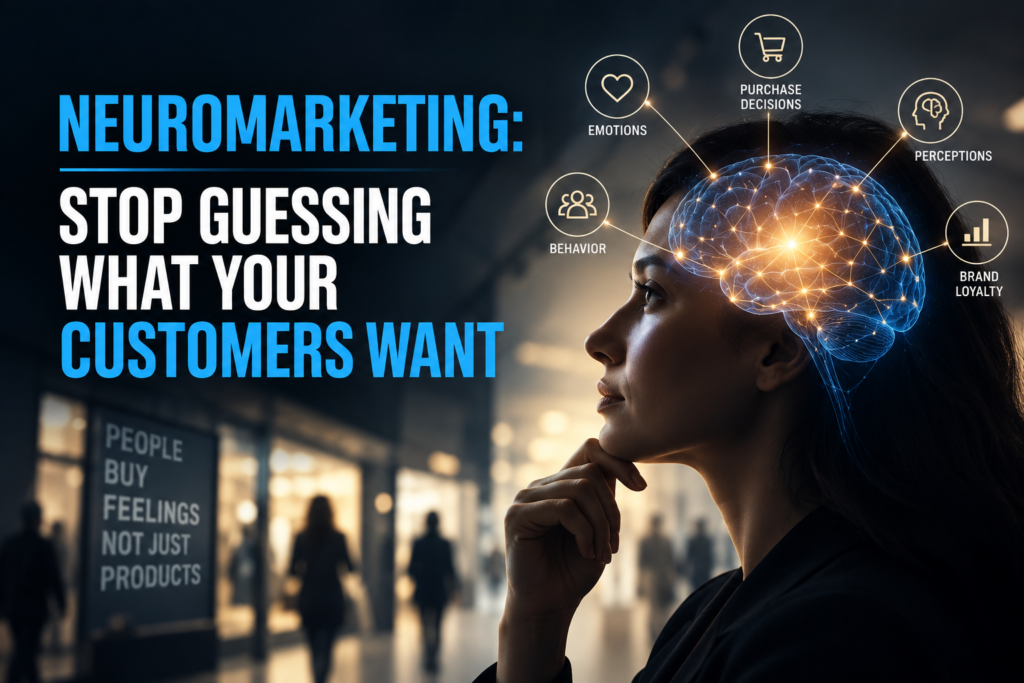
Neuromarketing combines insights from neuroscience, psychology, and marketing to understand how people respond to brands, advertisements, products, prices, and experiences. It looks at things such as attention, emotions, memory, preferences, and decision-making. While sophisticated neuromarketing research can involve tools such as eye-tracking, EEG, and other physiological measurements, the bigger lesson for everyday marketers is much simpler: understand the human being behind the customer profile.
A customer isn’t just a number, age group, income category, or location. A customer is a person with goals, fears, frustrations, habits, experiences, and expectations. When marketers understand those things, they can create better products and communicate their value more effectively.
1. Stop Looking at Customers as Numbers
One of the first things every marketer should learn is that demographics don’t tell the complete customer story. Knowing that your target customer is a 30-year-old urban professional with a certain income level is useful, but it doesn’t tell you what keeps that person awake at night.
Imagine you’re running an on-demand home-repair platform. You might initially think customers are mainly looking for low prices. But after talking to them, you may discover that their biggest concern is actually trust. They want a technician who will arrive on time, charge a fair price, do quality work, and behave professionally inside their home.
That’s a completely different insight.
The customer isn’t simply buying a repair service. They are buying convenience, reliability, and peace of mind.
This is why customer research needs to go deeper than basic demographic information. Ask yourself: What problem is the customer really trying to solve? What frustrates them? What are they afraid of? What outcome do they want?
2. Understand the “Why” Behind the Purchase
Customers don’t always buy a product for the reason businesses assume. A person may buy a gym membership, but what they really want is confidence. Someone may buy business coaching, but what they really want is freedom from constantly working in their business. Someone may buy a premium phone, but the motivation may include status, convenience, reliability, or simply the feeling of owning something better.
This is one of the most valuable lessons from understanding consumer psychology: features aren’t always the real reason people buy.
If you sell a productivity system, for example, you could talk about calendars, task management, templates, and planning tools. But your customer may be thinking, “I have too much on my plate, and I need to feel in control again.”
Your marketing becomes much stronger when you communicate the outcome rather than simply listing the features.
A good marketer therefore keeps asking, “Why does this matter to the customer?”
3. Emotions Influence Decisions
We like to believe that customers make completely rational decisions. We compare prices, analyze features, calculate benefits, and then choose the best option. In reality, emotions and perceptions often play an important role in decision-making.
Think about two businesses offering almost the same service at a similar price. One website looks confusing, has poor-quality information, and doesn’t clearly explain its policies. The other looks professional, has customer reviews, explains the process clearly, and makes the next step obvious.
Which one are you more likely to trust?
The second business may not actually provide a better service. But it feels safer.
That feeling matters.
Good marketing isn’t about manipulating emotions. It’s about understanding them and reducing unnecessary uncertainty. If customers are worried about risk, give them guarantees. If they want convenience, simplify the process. If they need trust, provide reviews, verification, testimonials, and transparent information.
4. Make Your Marketing Simple
Here’s a mistake entrepreneurs make all the time: they try to explain everything.
They want customers to know every feature, every technical specification, every process, every benefit, and every reason their company is better than competitors. The result is often marketing that contains plenty of information but very little clarity.
Your customer doesn’t necessarily need more information.
They need the right information at the right moment.
Compare these two messages:
“We provide a comprehensive digital platform incorporating technician verification, intelligent diagnostic capabilities, GPS-enabled tracking, payment integration, and customer feedback systems.”
Or:
“Find a trusted technician and get your home problem fixed without the hassle.”
The second message is easier to understand because it immediately communicates the value.
When customers understand what you do and why it matters, they don’t have to spend unnecessary mental energy figuring it out.
5. Study Behavior, Not Just What Customers Say
Customer interviews are extremely valuable, but there is an important principle every marketer should remember: what people say and what they do aren’t always the same.
A customer might tell you that price is the most important factor. But when they actually purchase, they might choose the more expensive option because it has better reviews or a stronger guarantee.
That’s why smart marketers look at both customer feedback and customer behavior.
Look at website clicks, abandoned carts, repeat purchases, cancellations, reviews, customer-support questions, and conversion rates. These behaviors can reveal patterns that customers themselves may not be able to explain.
Imagine 1,000 people visit your service-booking page but only 30 complete a booking. Instead of immediately spending more money on advertising, investigate what is happening. Maybe the pricing isn’t clear. Maybe customers don’t trust the technicians. Maybe the booking process is too complicated.
The data tells you what is happening. Customer conversations can help you understand why.
6. Analyze the Entire Customer Journey
A customer’s relationship with your business doesn’t begin when they purchase. It begins much earlier.
Maybe they discover your brand through social media. Then they visit your website. They read reviews. They compare competitors. They check pricing. They ask a friend. They leave your website. Three days later, they return and finally purchase.
Every interaction influences their decision.
That’s why marketers should map the customer journey from awareness to loyalty. Ask yourself where customers become interested, where they hesitate, and where they drop off.
For example, if customers frequently visit your website but don’t book your service, you may have an awareness problem solved but a conversion problem remaining. If customers book once but rarely return, the problem may be the customer experience rather than marketing.
This way of thinking changes the question from “How do I get more customers?” to “How do I make every step of the customer experience better?”
7. Use Data, But Don’t Forget Conversations
We live in a world where businesses can measure almost everything. We can track clicks, impressions, conversion rates, customer acquisition costs, retention, sales, and engagement. These metrics are incredibly useful.
But here’s the danger: entrepreneurs can become so focused on dashboards that they forget to talk to actual customers.
Imagine your conversion rate drops from 5% to 3%. The number tells you something is wrong, but it doesn’t tell you what happened.
So call a customer.
Ask them what they expected.
Ask what confused them.
Ask what nearly stopped them from buying.
Ask what they would change.
Sometimes one honest conversation can uncover an issue that hundreds of rows of data cannot explain.
The best marketers combine quantitative data with qualitative insight. Numbers show patterns. Conversations provide context.
8. Build a Culture of Continuous Learning
Perhaps the most important lesson of neuromarketing isn’t actually about neuroscience. It’s about mindset.
Markets change. Customers change. Technology changes. Competitors change. Expectations change.
The strategy that worked two years ago may not work today.
That’s why great marketers don’t say, “I already know my customer.”
They say, “I’m still learning about my customer.”
That mindset creates curiosity.
It encourages experimentation.
It makes you willing to test new messages, listen to feedback, analyze behavior, and improve the customer experience.
The same principle applies to leadership. A strong leader doesn’t assume they understand every employee. They ask questions. They listen. They observe. They learn what motivates different people and create an environment where people can perform at their best.
The ability to understand people is therefore not just a marketing skill. It is a leadership skill.
Bringing It All Together
Neuromarketing gives entrepreneurs an interesting way to think about customer behavior, but you don’t need to become a neuroscientist to apply its principles. Start with curiosity. Talk to your customers. Observe what they actually do. Understand their frustrations. Identify the emotions behind their decisions. Simplify your message. Study the entire customer journey. Use data to identify patterns, but use conversations to understand the reasons behind those patterns.
Most importantly, remember that ethical marketing isn’t about manipulating customers into buying something they don’t need. It’s about understanding what people genuinely value and communicating how your product or service can help them.
If you’re building a business, don’t ask only, “How can I sell more?”
Ask a better question:
“How can I understand my customer well enough to serve them better?”
That question changes the way you build products, create marketing campaigns, train sales teams, design customer experiences, and lead your organization.
The businesses that win aren’t always the businesses with the biggest advertising budgets or the most impressive products. Often, they’re the businesses that listen better, learn faster, and understand their customers more deeply.
Because behind every click, every purchase, every review, and every number in your analytics dashboard is a human being.
Understand the human, and you’ll understand the market.