For decades, productivity has been one of the clearest measures of managerial success. Managers are expected to make teams faster, processes smoother, costs lower, and outcomes better. Numbers provide reassurance: targets can be measured, deadlines can be tracked, and performance can be compared. In a business environment increasingly dominated by dashboards, analytics, and performance metrics, productivity appears to offer leaders something particularly valuable—certainty. But there is a problem with treating productivity as the ultimate measure of organizational success. A person can be productive without being fulfilled. A team can meet its targets while becoming exhausted. An organization can achieve record performance while quietly losing creativity, loyalty, and human potential. This creates one of the most important dilemmas facing modern managers: Should leaders optimize what employees produce today, or protect the human capacity that allows them to produce tomorrow?
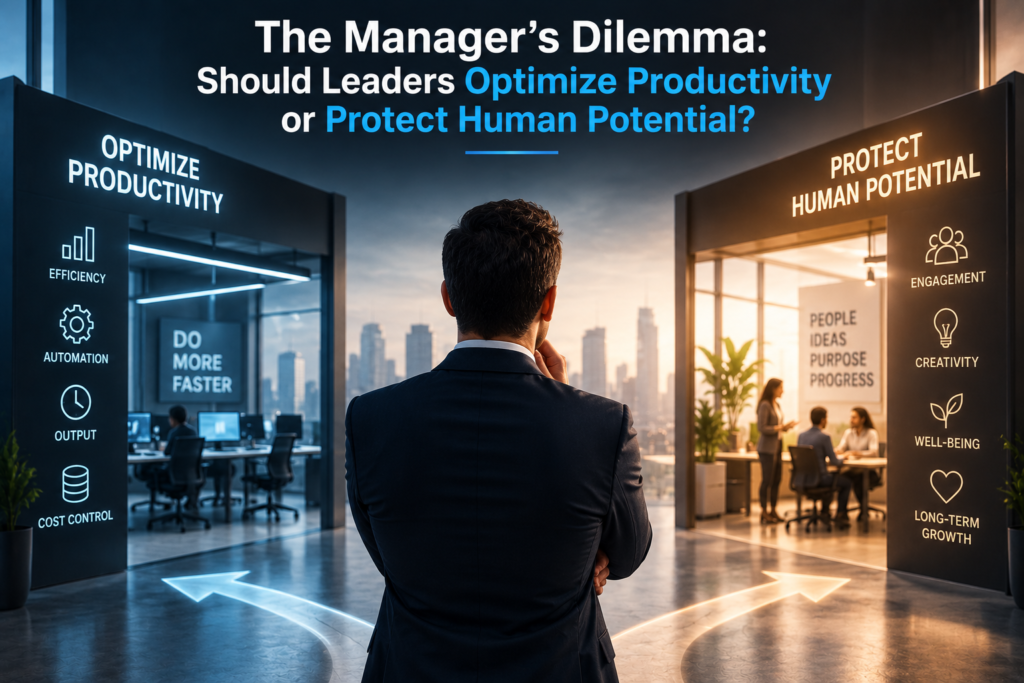
The question is more complicated than choosing between productivity and employee well-being. In reality, organizations need both. Businesses cannot ignore performance, just as employees cannot thrive indefinitely in environments where every hour is optimized for output. The real challenge lies in understanding that human potential is not separate from productivity. It is one of its underlying sources. When employees have the energy to think, the freedom to experiment, the confidence to speak, and the psychological space to learn, they contribute more than the immediate task assigned to them. They bring ideas, judgment, relationships, adaptability, and creativity. These qualities are difficult to measure on a daily performance dashboard, but they can determine whether an organization remains competitive over time.
This is where the traditional definition of productivity begins to look incomplete. Productivity is often associated with doing more in less time. But doing more is not always the same as creating more value. A manager who pushes employees to answer more emails, attend more meetings, complete more tasks, and work longer hours may create the appearance of high productivity. Yet if employees become mentally exhausted, make more mistakes, stop experimenting, or eventually leave the organization, the apparent efficiency may have been extremely expensive. The organization has optimized the visible output while damaging the invisible system that produced it.
Modern management therefore requires leaders to distinguish between short-term efficiency and long-term effectiveness.
Imagine two teams. The first consistently works late, responds immediately to every request, rarely takes breaks, and meets aggressive targets. On paper, it looks highly productive. The second team has clearer boundaries, greater autonomy, time for learning, and a culture in which employees can question inefficient processes. Its output may occasionally appear slower. But over several years, the second team may develop stronger expertise, generate better ideas, retain more institutional knowledge, and adapt more effectively when circumstances change. Which team is actually more productive? The answer depends on whether productivity is measured at the end of the week or across the life of the organization.
This distinction matters because human beings are not machines. A machine can theoretically be optimized by increasing utilization. People cannot. Human performance is affected by sleep, stress, motivation, relationships, purpose, psychological safety, workload, and a sense of control. Ignoring these factors does not eliminate them; it simply makes their consequences less visible until they appear as absenteeism, disengagement, errors, conflict, turnover, or burnout.
Burnout is therefore not merely an individual problem. It can also be interpreted as a management signal. When employees repeatedly experience excessive demands without sufficient recovery or resources, organizations should ask whether their systems are designed around sustainable performance or continuous extraction. The manager’s responsibility is not to ensure that every employee is comfortable at all times. Work inevitably involves pressure, deadlines, accountability, and difficult challenges. The responsibility is to understand whether pressure is producing growth or gradually consuming the capacity to perform.
This creates a difficult leadership paradox. The pressure that produces performance in the short term can sometimes destroy performance in the long term.
A deadline can motivate a team to focus. Too many deadlines can create chronic stress. A demanding manager can push employees beyond what they believe they can achieve. Constant pressure can eventually make employees afraid to take risks. A competitive environment can encourage ambition. Excessive competition can undermine collaboration. Performance targets can create clarity. Poorly designed targets can encourage employees to optimize the metric rather than the mission.
The problem, therefore, may not be performance measurement itself. The problem is what organizations choose to measure.
If employees are evaluated primarily on the number of tasks completed, they will naturally prioritize task completion. If managers are rewarded only for quarterly results, long-term employee development may receive less attention. If responsiveness is treated as a sign of commitment, employees may feel pressure to remain constantly available. If working long hours is interpreted as dedication, sustainable work practices can become difficult to maintain.
Metrics are not neutral. They influence behaviour.
This is why sophisticated managers need to look beyond output and ask what produces that output. A healthy performance system might consider not only what was achieved but also how it was achieved. Did the team develop new capabilities? Did employees learn? Were processes improved? Did the manager create greater independence within the team? Did the organization become less dependent on one individual? Did employees feel safe enough to raise problems before those problems became expensive?
These questions shift management from performance monitoring to capacity building.
A manager who only monitors performance asks, “Did you complete the task?” A manager who builds capacity asks, “What would help you perform this task better next time without requiring the same level of intervention?” The first approach produces immediate results. The second produces capability.
That distinction is particularly important in an economy where knowledge, creativity, and adaptability increasingly matter. Employees are not valuable only because of what they currently know. They are valuable because of what they can learn, create, solve, and become capable of doing. Human potential is therefore a form of organizational capital.
Yet potential is fragile. Employees who are never given autonomy may stop taking initiative. Employees who are punished for mistakes may stop experimenting. Employees whose ideas are repeatedly ignored may stop contributing them. Employees who are promoted without being developed may eventually struggle under responsibilities they were never prepared to handle. In each case, the organization loses something that may never appear directly on a financial statement.
This is where psychological safety becomes particularly relevant to management. A psychologically safe workplace does not mean a workplace without accountability. It means employees can raise concerns, ask questions, admit mistakes, and challenge assumptions without fearing humiliation or disproportionate punishment. Such an environment can improve organizational learning because problems become visible earlier. When employees believe that speaking honestly is dangerous, managers may receive polished reports instead of accurate information.
For leaders, this creates another uncomfortable reality: silence can look like agreement.
An employee who says nothing in a meeting may not necessarily support the decision. They may simply believe that disagreeing is pointless or risky. A team that appears cooperative may actually have stopped challenging its leader. A manager who believes there is no resistance may therefore be managing an environment where people have learned not to express resistance.
Protecting human potential means creating space for disagreement without allowing disagreement to become dysfunction. Good managers do not eliminate friction; they learn how to make productive friction possible.
Autonomy is another important part of this equation. When managers attempt to control every detail of how work is performed, they may unintentionally reduce ownership. Employees become dependent on instructions rather than developing judgment. Delegation, therefore, should not simply mean distributing tasks. It should mean distributing responsibility and decision-making authority.
The strongest managers eventually become less necessary for routine decisions because they have developed capable people who can make those decisions themselves.
This may initially feel uncomfortable. Managers are often promoted because they are good at solving problems. But if a manager personally solves every problem, the team may never learn to solve them independently. Leadership development therefore involves a strange transition: the manager must become successful at making themselves less essential.
Technology adds another layer to this dilemma. Artificial intelligence, automation, analytics, and digital monitoring can help organizations identify inefficiencies and improve productivity. They can reduce repetitive work, support decision-making, and provide managers with more information than ever before. But technology can also encourage organizations to measure everything simply because measurement is possible.
A workplace where every click, response time, keystroke, meeting, and task is monitored may produce enormous amounts of data without necessarily producing better performance. Measurement can become surveillance, and surveillance can alter behaviour. Employees may begin optimizing for what the system can see rather than what the organization actually needs.
The irony is that some of the most valuable forms of work are difficult to measure.
How do you quantify the employee who prevents a conflict before it becomes a problem? How do you measure the value of a conversation that gives a struggling colleague the confidence to continue? How do you calculate the future value of an idea that takes six months to develop? How do you assign a productivity score to curiosity?
Not everything important is immediately measurable.
This does not mean managers should abandon data. It means data should be treated as evidence rather than reality itself. A performance dashboard can tell a manager what is happening according to the metrics being measured. It cannot necessarily explain everything that is happening.
The most effective managers therefore operate between two worlds. One is quantitative: targets, costs, deadlines, revenue, efficiency, quality, and performance. The other is human: motivation, relationships, learning, creativity, trust, energy, and purpose. Leadership becomes the ability to connect these worlds rather than allowing one to dominate the other.
Perhaps the most useful question is not, “How can we get more out of our employees?” but “How can we create conditions in which employees can contribute more without exhausting the capacity that makes their contribution possible?”
That question changes the role of management.
Instead of seeing employee well-being as an expense that must be balanced against productivity, organizations can view sustainable well-being as part of their performance infrastructure. Rest becomes relevant because recovery affects performance. Learning becomes relevant because skills determine future capability. Autonomy becomes relevant because ownership influences initiative. Psychological safety becomes relevant because information and learning depend on people’s willingness to speak honestly.
This does not mean that managers should lower standards. In fact, protecting human potential may require higher standards, not lower ones. The difference is that high standards should be accompanied by clarity, resources, development, and realistic expectations.
A leader who tells an employee, “You need to perform better,” provides pressure. A leader who says, “Here is where your performance needs to improve, here is what success looks like, and here is what I will do to help you develop the capability to reach it,” provides a pathway.
The first creates accountability.
The second creates accountability and capacity.
Ultimately, the manager’s dilemma may be based on a false choice. Productivity and human potential are not enemies. The problem occurs when organizations pursue productivity in ways that consume the very human capabilities on which future productivity depends.
The organization of the future will need managers who understand this distinction. They will still care about targets, efficiency, profitability, and performance. But they will also understand that an employee is not simply a unit of output. Every employee represents a combination of knowledge, creativity, relationships, judgment, experience, and unrealized potential.
The question for modern leaders is therefore not whether productivity matters. It unquestionably does.
The more important question is:
What kind of productivity are we building?
Is it productivity that depends on exhaustion, constant supervision, and short-term pressure? Or is it productivity built on capable people, intelligent systems, trust, learning, autonomy, and sustainable performance?
The first can produce impressive numbers.
The second can produce an organization that continues to perform when circumstances change.
And perhaps that is the real test of management—not how much a leader can extract from people today, but how much capability they leave behind for tomorrow.