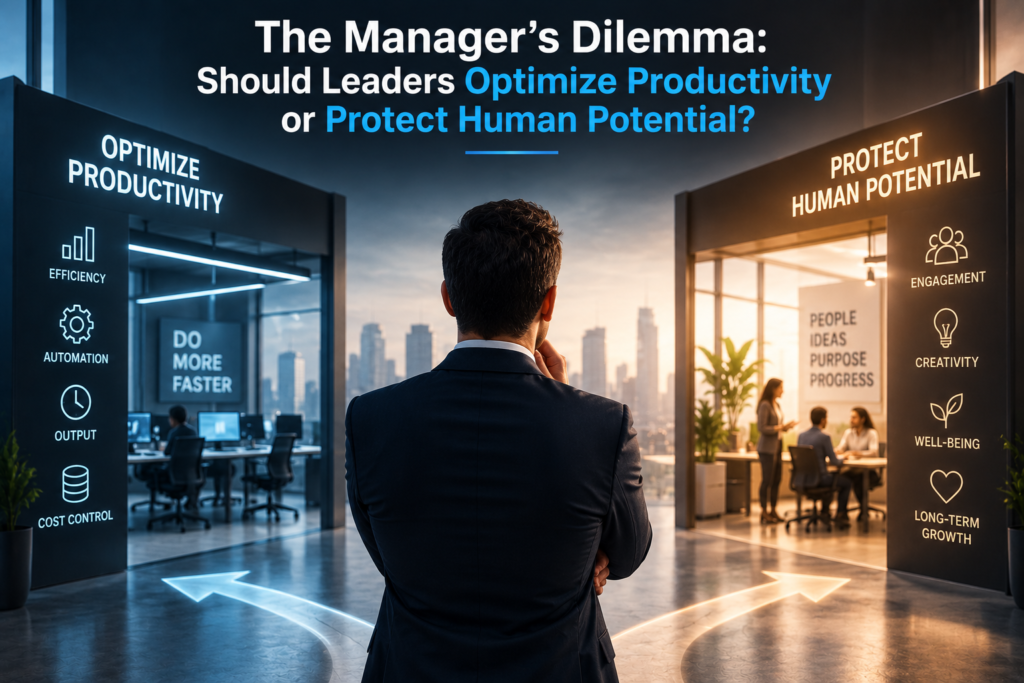
Imagine walking into a company thirty years ago and asking a manager what their team needed from them to perform better. The answer would probably have been relatively straightforward: clear instructions, discipline, resources, accountability and someone to make the final decision. That model worked because the nature of work was different. Businesses operated in more predictable environments, information moved slowly, roles were clearly defined, and employees were often expected to execute processes that had already been established. Management was largely about maintaining control, coordinating people and ensuring that work was completed as expected.
Now ask the same question to a manager leading a team in 2026, and the answer becomes much more complicated. Teams may be distributed across cities and countries. Employees may be working alongside artificial intelligence. Customers can change their expectations within weeks. A junior employee may have access to information that would have taken a senior executive days to obtain a few decades ago. Markets shift quickly, technology changes constantly and many of the problems facing organizations do not come with predetermined solutions. The manager is no longer simply operating a system where every person has a fixed function. The manager is leading a system that is constantly learning, changing and adapting.
That is the real story behind the evolution of management. Management has not become less important; it has become more complex. The traditional manager was often measured by how effectively they could control execution, maintain discipline and ensure that targets were achieved. The modern manager is increasingly measured by how effectively they can create clarity, develop people, distribute decision-making, remove bottlenecks and build an organization that can perform without depending on one person for every answer. That distinction becomes especially important as companies grow, because eventually the founder, CEO or senior manager reaches a point where they simply cannot make every decision themselves. At that stage, growth is no longer only about acquiring more customers or generating more revenue. It becomes about building more people who can make good decisions and take meaningful ownership.
The Manager’s Real Job Is Changing
For a long time, management was closely associated with supervision. Someone had to make sure that employees were doing their work, deadlines were being met and processes were being followed. Those responsibilities have not disappeared, and they never should. A business without accountability quickly loses direction. What has changed is that supervision alone is no longer enough. The World Economic Forum’s Future of Jobs Report 2025 found that analytical thinking remains the most important core skill for employers, while resilience, flexibility, agility, leadership and social influence are also among the capabilities organizations increasingly need. The report also estimates that 39% of workers’ existing skill sets could be transformed or become outdated between 2025 and 2030.
For managers, that creates a significant responsibility. If the skills required by a business are continuously changing, managers cannot simply manage the capabilities employees already possess. They have to help develop the capabilities the organization will need next. This changes the managerial question from simply asking whether an employee is doing their job to asking whether that employee is becoming more capable. It also creates a deeper question for leaders: is the team becoming more capable without becoming more dependent on the manager? That is where modern management begins to move beyond supervision and into capability building.
From Giving Answers to Creating Better Thinkers
One of the clearest differences in management can be seen in what happens when an employee brings a problem to their manager. An employee might say that there is an issue with a client, a process or a project, and the manager can immediately provide the solution. This approach can be efficient in the short term, but if it happens repeatedly, the manager becomes the team’s problem-solving engine. Employees learn to bring questions upward rather than developing the confidence and judgment to solve problems themselves.
A stronger approach is for the manager to ask what the employee thinks is causing the problem, what options they have considered, which solution they would recommend and what information they need to make the decision. The manager may spend a few additional minutes in that conversation, but something more valuable is happening: the employee is developing judgment. This is one of the most important responsibilities of modern leadership. A manager should not simply create employees who know how to follow instructions; they should create employees who know how to think, evaluate situations and make increasingly better decisions. As a company grows, that distinction becomes critical. When every decision travels upward, growth creates congestion. When decision-making capability travels throughout the organization, growth creates leverage.
Development Is No Longer an HR Initiative
A company does not truly scale simply because it hires more people. It scales when those people become capable of taking ownership of increasingly valuable problems. This is why employee development should not be viewed purely as an HR responsibility. It is a business-growth strategy.
Consider two organizations that hire equally talented people. The first gives employees clearly defined responsibilities and primarily measures whether those responsibilities are completed. The second does the same but also deliberately develops employees by giving them increasingly difficult problems, encouraging decision-making, providing regular feedback and gradually expanding their ownership. Both organizations may look similar during their early stages. But over time, the second organization begins to develop something far more valuable: organizational capability. It doesn’t simply have more employees; it has more people capable of solving problems, leading initiatives and making decisions.
The World Economic Forum’s research estimates that 59 out of every 100 workers will require training or reskilling by 2030. For managers, the implication is significant. Development cannot be something that happens only when an employee attends a training program or when the company introduces a new learning initiative. Everyday work itself has to become part of the development process. A difficult project can become a leadership opportunity. A challenging client can become a communication lesson. A mistake can become a coaching conversation. A new responsibility can become the first step toward leadership. Managers who recognize these opportunities are not simply managing today’s workforce; they are building tomorrow’s workforce.
The End of the “Wait Until the Annual Review” Mentality
There is something fundamentally strange about traditional performance management. A problem can occur in January, February and March, yet the employee may only hear about it during a formal performance discussion months later. By that point, the behaviour may already have become a habit. Modern management increasingly recognizes the importance of shorter feedback loops. This does not mean that formal performance reviews are unnecessary. It means they should be supported by regular conversations about performance, expectations, progress and development.
A strong manager does not wait months to tell someone that their communication needs improvement. They also do not wait until the end of a quarter to recognize excellent work. Instead, they create a rhythm in which employees understand what they are doing well, where they need to improve and what support they need to perform at a higher level. Gallup’s research has consistently highlighted the importance of managers in shaping employee engagement and team performance, with its research estimating that managers account for approximately 70% of the variance in team-level engagement. Gallup also emphasizes the manager’s role in setting expectations, coaching performance, recognizing contributions and connecting employees with purpose.
This makes the manager much more than an administrative layer between senior leadership and employees. The manager becomes part of the organization’s everyday performance infrastructure. The quality of the manager’s conversations can influence how clearly employees understand their priorities, how quickly they correct mistakes and how confidently they take ownership.
Psychological Safety Is Really About Better Information
Another major development in modern management is the growing emphasis on psychological safety. The term is sometimes misunderstood as creating an environment where everyone feels comfortable all the time or where difficult conversations are avoided. In reality, psychological safety is much more useful than that. It is about whether people feel able to speak honestly, ask questions, acknowledge mistakes and challenge ideas without fear of humiliation or punishment.
That has direct business implications. Every organization makes decisions based on the information available to it. If employees are afraid to report problems, leaders receive incomplete information. If people are afraid to challenge assumptions, poor ideas can survive longer than they should. If employees hide mistakes because they fear the consequences, the organization loses the opportunity to learn from them. Harvard Business Review’s work on psychological safety emphasizes the importance of creating an environment where people can speak up with candour.
For managers, this creates an important distinction. A high-performing team is not necessarily a team where everyone agrees with the manager. It is a team where someone can say, “I think we’re wrong,” without believing that doing so will damage their career. Healthy disagreement is often a sign that information is moving through the organization. The objective is not to remove conflict but to make disagreement productive. Managers who can create that environment give their companies access to information that might otherwise remain hidden.
Delegation Is About Creating Ownership, Not Just Reducing Work
Delegation is another area where modern management requires a deeper perspective. It is often presented as a productivity technique: give someone else the task so you can focus on something more important. That is useful, but it misses the larger opportunity. The real purpose of delegation is to increase the number of decisions and responsibilities an organization can handle without increasing its dependence on a single manager.
There is a significant difference between giving someone a task and giving someone ownership. Telling an employee to prepare a report is delegation of a task. Giving that employee responsibility for ensuring that leadership receives accurate reporting every Monday, identifying unusual trends and recommending actions is delegation of an outcome. The second approach requires greater trust, but it also develops significantly more capability.
This is where delegation becomes connected to scalability. A manager who delegates only tasks creates assistants. A manager who delegates ownership creates people who can eventually lead. The goal is not simply to make the manager less busy. The goal is to make the organization less dependent on the manager. That distinction becomes increasingly important as businesses grow, because the manager’s personal capacity should not become the ceiling of the organization’s capacity.
Technology Is Changing What Managers Need to Manage
Artificial intelligence has added another dimension to this transformation. For years, businesses primarily asked whether technology could help employees perform existing tasks faster. The more important question now is whether technology changes the way those tasks should exist in the first place.
AI can increasingly support research, summarization, analysis, drafting, data processing, customer support and many other knowledge-work activities. But that does not make managers irrelevant. Instead, it changes the nature of managerial work. The World Economic Forum identifies AI and big data among the fastest-growing skill areas while simultaneously identifying analytical thinking, creative thinking, resilience and leadership as critical capabilities. McKinsey has similarly argued that AI agents are likely to change managerial work and place greater emphasis on people leadership and the orchestration of human and AI capabilities.
The manager’s role therefore increasingly involves deciding what should be automated, what should be augmented by technology and what requires human judgment. The strongest managers will not simply introduce AI tools into existing workflows and call the organization innovative. They will examine the workflow itself and ask whether the work should be designed differently. Technology creates real leverage when it changes the effectiveness, speed or economics of work—not merely because another tool has been added to the company’s software stack.
The “What Happens If You Leave?” Test
There is a simple test that every manager should occasionally apply to their own team: what would happen if you were completely unavailable for thirty days? Not on vacation with your phone beside you, but genuinely unavailable. Would the team continue making decisions? Would customers still receive what they need? Would projects keep moving? Would employees know who owns what? Could problems be solved without everything being escalated to you?
The answer reveals something important about the management system. If everything stops when the manager is absent, the organization may not have a people problem. It may have a dependency problem.
The purpose of management is therefore not to make the manager indispensable. In many ways, it is the opposite. The strongest managers build teams that can perform exceptionally well without requiring the manager to be involved in every decision. That does not make the manager less valuable. It demonstrates that the manager has successfully transferred knowledge, developed judgment, established accountability and created systems that allow other people to lead.
Growth Eventually Becomes a Management Problem
Business growth is usually discussed in terms of revenue, customers, products and market share. But underneath those visible metrics is another factor that receives far less attention: managerial capacity.
A founder can personally manage a small number of customers, approve expenses, review sales conversations, solve operational issues and train employees. As the company grows, however, the number of decisions eventually exceeds one person’s capacity. The business may have enough customers and opportunities, but communication becomes slower, approvals become bottlenecks and the founder or senior manager becomes the final checkpoint for everything.
This is the point at which many companies discover an uncomfortable truth: sometimes what limits growth is not demand but management capacity. Growth has created complexity faster than the company has created leadership capability. The solution is not simply for the leader to work longer hours. The solution is to build systems, managers and decision-making structures that allow the organization to handle more complexity.
This is why leadership development, delegation, communication, accountability and operational systems belong in the same conversation as business growth. They are not separate subjects. They are different parts of the same organizational infrastructure.
The Companies That Scale Multiply Capability
Revenue can be multiplied. Customers can be multiplied. Products can be multiplied. But none of those things scale sustainably if managerial capability remains concentrated in a handful of people.
That is why the next generation of managers needs to think differently about what their role actually means. A manager’s responsibility is not simply to make sure the team finishes today’s work. It is to build a team that is more capable of handling tomorrow’s work. It is not simply to solve today’s problem, but to teach people how to approach the next one. It is not simply to delegate a workload, but to distribute ownership. It is not simply to adopt AI, but to rethink how work should be designed in an AI-enabled organization.
The evolution of management is therefore not about abandoning everything that came before. Discipline still matters. Accountability still matters. Standards still matter. Planning still matters. What has changed is the manager’s understanding of how those principles are applied in an environment where information moves faster, skills evolve continuously and employees are expected to contribute more than simply execute instructions.
The traditional manager asked, “How do I get my people to perform?” The modern manager has to ask a much bigger question: “How do I build people, systems and an environment that make high performance repeatable?”
That question changes everything.
Because eventually, every founder reaches a ceiling. Every manager runs out of hours. Every leader reaches a point where personal effort alone cannot carry the organization forward. The companies that continue growing are the ones that learn how to turn individual capability into organizational capability.
And perhaps that is the most important management skill of all: building an organization that becomes more capable than the person who started it.